Leaf Lace Earring Organizer
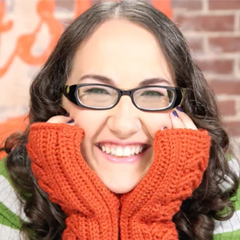
Brenda K.B. AndersonTurn a thrifted photo frame into a stylish earring organizer with a touch of knitted lace! This functional piece of home décor features a beautiful wandering vine stitch pattern, perfect for showcasing your earring collection.

Hey, everybody. My name's Brenda K.B. Anderson and I design knit projects, crochet projects, and sewing projects, and then I share them with you guys. So I'm excited today to show you guys my newest project. So this is the leaf lace earring organizer.
This was born out of frustration Oops, my earring fell out. because I have a kid that got their ears pierced semi-recently, and I have been finding them everywhere all over my house. So I'm like, "Okay, we need to have an easy place for her to put them away," and so, yeah. So I designed this. So this is just a little bit of knitted lace here that's stretched taut in a, a repurposed frame that I found at the thrift store.
So I thought this would be a really great project for, you know, using up some scrap yarn if you have some, and then, you know, thrifting a frame. They almost always have frames at the, the thrift stores that I go to. I mean, I don't think I've ever been there when they didn't have a frame. I've been thinking about this project for quite a while, and I would check on them every once in a while, and then when I decided, yes, I'm actually gonna do this project, I went and they, they had like five different frames that I could choose from in the, in the same size even. so yes.
So I would recommend checking your thrift store first if you wanna do this project because it's very likely you could save a little bit of money and, you know, reduce waste by recycling something that, already exists. so let, let's first talk about the materials. I mean, we did talk a little bit about the frame, but we'll back to that in a minute. so the first thing that we need, of course, is the yarn. and this is a sport weight yarn.
I'm using a cotton yarn, so this is like, I think it's like a six ply or something like that. it has very, very little stretch to it, which is important because once you stretch this tight over, over your frame and attach it to the frame, you want it to be taut, you know, kind of like a drum. It doesn't have to be quite that tight, but you want it to be quite taut and you don't want it to stretch out over time. You just, want it to be tight so that, you know, even if you have a bajillion earrings that you're hanging from it, it's not gonna make it look kinda saggy or stretch it out. So, that's what we're going for here.
If you wanna see exactly the yarn that I used and the color and all that information, that's in your download, which, is free indefinitely, so you can go ahead and download that and follow along if you like. and, if, but oh, like what I was saying is, if you wanna substitute, you know, I think it's best if you substitute with another plant fiber, so like a cotton, hemp, linen, something like that that does not have very much stretch. I think that would be your best bet. I think that a crochet cotton in a size three, if you have that, I think that that would actually be a good substitute, as well. So I know, I just know that that's something that might be a little more, more common in some people's houses.
yeah. And I did, this, this yarn that I'm using here today, this is a little bit more prev- prevalent in Europe, but you can get it on Etsy and I have seen it in some craft stores in the US as well. but f- you know, feel free to substitute with something else. of cou- okay, so we're gonna need about 75 yards of the yarn, and then I'm using size two knitting needles, but you will use whatever needles that you need to in order to get a gauge that's gonna work for your project. So I do have a gauge given in my pattern, but I think it's best if you just, you know, start out with something, you know, start out with your size two needles, knit up a little bit, and just kinda monitor it as you're going, because it's really not a very large piece.
It's barely larger than, you know, it's about six inches wide, the thing that we're making, so that's just barely wider than a gauge swatch. So I just recommend you just jump right into it, and start knitting up your piece. This is actually what the whole piece looks like, after it's done being knit. And, so, you know, y- and then you can feel how much it's going to stretch when you put it in the frame. So if you only had like a little section of it knit up, you know, you can say, "Oh, is that gonna stretch wide enough for my frame?" Perfect.
You want this to be smaller than your frame, okay? Like you want to have to stretch it taut in order to fit in your frame. And so one thing that I noticed, you know, or w- was thinking about when I designed this project is I thought, you know, if you're substituting with a different yarn, then it might not have the exact kind of stretch. So I wanted to give you some tips on how to make sure that your lace is going to fit. So I do have some information in your pattern download about how to add another lace repeat or subtract another lace repeat, so you can add, in groups of 10 stitches to your cast on or take away in groups of 10 stitches from your cast on, if you want it to be larger or smaller than this piece, if you have to kind of adjust in that way.
Another thing to think about, too, and then of course you can, work it, the, the piece until it's the right length that you want it to be. But I do wanna point out one thing, is that when you are placing this in your frame, I just think this is all very good to have in mind before you, before you start because then you can kinda monitor things as, as you're working. But, you know, m- this is going to fill up the space. You can see how much it has to stretch in order to fit in there, and it may not have to stretch as much in this dir- or, as much in this direction. It's almost long enough, but it does have to stretch quite a bit in this direction.
So if you're, you're working up your piece and it's a little narrower than mine, you could decide if you wanna add another repeat, and in which case you won't have to stretch it very much widthwise, but then you may wanna stop it a little bit earlier to make it a little bit shorter so that you can still get it to be taut. Because you're gonna pull in this direction and in this direction, so keep that in mind, when you're checking your lace against your frame. Okay. So, so I guess all that to say gauge is important, but you can kinda mess around with the stitch count in order to make this work if you wanna substitute with a different yarn weight or something like that. that's absolutely, th- that should be just fine.Okay, so and of course, back to the frame, you are gonna need some sort of, like, an 8 by 10 frame, unless you feel like you wanna alter your, your lace pattern to fit in a different frame, you could do that.
but this pattern was designed to be using an 8 by 10 inch frame, and then you'll want the style of frame where you can just remove the backing completely out, so, the majority of the frames that I found at the thrift store were like this. They had these little, I don't know what they're called, but this little hardware that keeps the, the board and the back in place. So you should be able to take that out, take out any of the other stuff that's in your frame, including the glass. We don't need that. We don't need any of these parts.
I end up keeping my glass because I use that. I have a hot melt knife, and I sometimes work on projects where I use that to cut fabrics and that sort of thing when I don't want it to fray, so that's what I use my glass for, but maybe you guys will have a different purpose for your glass. Or maybe somebody else in your neighborhood could u- maybe they broke their photo frame, and they need a new piece of glass, so you could post that for free. so basically, this is what you need, some sort of frame that has a little bit of a lip here that you can glue to and, 'cause you're gonna be gluing your knitted fabric to the wrong side, and then it'll be stretched taut and look nice and polished from the right side of your frame. All right, and, and I'm gonna be using s- well, I'll be using straight needles to start out with, and then I'm gonna switch to circular needles.
It doesn't matter what kind of knitting needles you use. You can use straight. You can use your circular. We're just knitting back and forth. we're knitin- knitting a flat piece.
and I'm gonna be using a US size two, which is two point seven five millimeters, so, but like I said, you will, you will use whatever size makes sense for your project, whatever gets you the correct gauge. and you will need a, a tapestry needle to weave in your ends, and also you'll need a glue gun and some hot glue. So I'll be using that, towards the end of this process so that I can show you how to attach your, lace piece into your frame. All right, so if you guys have any questions as we're going along here, definitely put them in the chat, and I'll try to answer them as we are working up this project. I'm going to be starting out with just teaching you how to knit this lace panel, so even if you're here not because you wanna make an earring frame, but you just wanna learn how to make this kind of lace, it's, you know, I'll be teaching you that, and you could make something else out of your lace, like a scarf or a table runner or something else.
oh, and we've got a hello from Sandy. Hi, Sandy. Thanks for being here. Thanks for saying hi. Yeah, if you guys wanna say hi and where you're knitting from today, let me know.
I always like to hear from you guys. So yeah, if you have any questions, if you just wanna say hi, or if you have suggestions for things you wanna learn in the future, you can always put that in the chat as well. I'm always interested to hear what you guys are thinking about and what you guys are interested in learning, so. All right, so when you cast on your stitches, we're gonna start out with 45 stitches. I'm not gonna cast on that many, because I'm gonna do sort of a reduced sample so you don't have to watch me repeat the lace pattern over and over and over.
but when you cast on your stitches, use whatever cast on you like that's stretchy because we are going to be trying to str- you don't wanna, you don't want the cast on to keep you from stretching your fabric taut and placing it in that frame. So you'll probably, if you wanna start out with a German twisted cast on, that's what I'm gonna be doing. So you're gonna make a little slip knot. I usually leave about, I don't know, maybe a yard and a half or so, of a yarn tail for this project. Place that on your needle.
And so I have the ball of yarn here, and then the strand that's, the beginning yarn tail is right here, and I'm gonna hold that in slingshot, slingshot position like this with my hand, and I'm gonna go underneath both of these strands here, around over the top, and then I'm gonna go over here, over the top, and then pull it through that little tiny triangle, and then just drop my thumb and pull it up. I'll show you that again. But the, we do have videos on the Knitting Circle website if you guys want a more in-depth on the, the German t- twisted cast on. So I'm gonna go underneath here, scoop around, come down through the middle, and then I'm gonna go over here, around that strand, and I'm gonna pull it through that tiny little triangle like that. Okay, so I'm gonna do that a little quicker now.
Oops. So I'll just get a few cast on here, and then I can show you the next step. So just imagine you were casting on 45 stitches onto your knit- knitting needle here. And make sure you're doing these loose enough that you can work into them. If you need to, you can, s- you know, s- do this on a larger needle if that helps you.
All right, I'll just get a couple more cast on there, and then we'll just all imagine that that was 45. All right. Okay, so the next step is you're going to just knit three rows. Okay, so that's simple. This is sort of the beginning frame.
I wanted to have some fairly dense stitches along each side edge and on the, along the top and the bottom of this little lace panel just so that, you know, just knowing that I would wanna be able to have more of a surface to glue to. So we're just knitting all across that first row.There we go. All right, so we're knitting We knit row number one, and we're gonna turn our work, and we're gonna knit two more rows, okay? So row number two and row number three. So I'm gonna switch over to my next sample here.
So even though this is on, my circular needle, that's just It's just because it makes it a little bit easier for me to not be making noise with the ends of the needles hitting the, the table. but I didn't have enough of these, so that's why I started out with the straight needles. Okay, so I've knit three rows back and forth. And just to let you know, this is not 45 stitches. This is only 35.
This is just one repeat short of what, what I want you guys to make for the 8x10 frame. I just reduced it by one repeat just so that you wouldn't have to watch so much, you know, of the same, same stitches over and over again. so I, I did write down the whole The full pattern is in here. All the complete instructions are in your download, as well as a couple of pictures, materials list, and all that. And I do have a chart.
So I'm gonna be teaching from the chart because I'm It's easier for me to teach from charts so that, I can actually see where my stitches are compared to the other stitches. And I'll be talking a little bit about the chart as I work from it, but if, y- you know, if you are not a chart reader, you don't enjoy working from a chart, that's okay. You don't have to look at the chart. You can just read from the directions. I have the full directions all written out, so you don't, you don't have to look at the chart at all if you don't want to.
'Cause I know there's lots of different ways of learning things, and for some people, they like charts, and some people, it doesn't really help. So all right. So, I have already worked through row number three of the chart. So just to let you know in case you're a little newer to reading a knitting chart, there's a little key down here that tells you what all the stitches mean. The red line right here, that's just showing a stitch repeat, a row repeat, actually.
Between this line and this line, we're gonna repeat that. And I did fully chart out your piece all the way across even though there's repeats in here. I wouldn't have needed to char- to, to, show all of the repeats here, but I find it easier to keep my place when I'm working from a chart, and it's not such a wide piece that it wouldn't have fit on the page. So I, I end up charting the entire thing all the way across, and then we just have these row repeats. So once we get to the red line section, we're going to repeat this section over and over again.
and then we'll just finish up with those last three rows when it's to the length that we want it to be. so I've already worked the first three rows, and just to let you know, these gray lines, right, or these gray boxes right here, that means no stitch, which just means you just skip over it. It's not like there's a It's not like you don't work the next stitch on the needle. You just move to the next stitch here in your chart, and y- and that becomes the next stitch that you do on the needle. I'll show you as we're working across.
But basically, it's a placeholder. and the reason you see a lot of this in lace is because you're kinda moving around, with increases and decreases. It, y- you know, it becomes a difficult thing to chart on a grid. So, so those placeholders just basically, allow you to put those, Like for example, this little kinda looks like a tent with a seven in it. That's a s- knit seven together stitch right there.
So that's taking seven stitches, these stitches, and combining them all into one stitch. so you can see all of those kinda get used up and become part of that stitch. So, the gray is just something you skip over with your eyes as you come to it in the chart, and then you move to the next stitch and work the next stitch on your needles. Okay, so we have done rows one, two, and three of the directions or of the chart, and we're already up to where this red line is. We're gonna start doing our lace repeat.
So the first row is row number four, and we are actually gonna be starting from the left side of the chart and reading that across to the right because the little number four is over on the left side. That's gonna tell you where to start reading your chart from. And these little vertical lines, as you are looking at the front of your lace piece, those look like knit stitches. But because we're working a wrong side row, and we're reading the chart from left to right, that means we're working a wrong side row, that is going to become a purl. So purl, purl, knit, purl, purl, purl, purl, purl.
eight purls in a row there. So we're gonna start out doing Let's see. Here we go. Start out doing two purls, so two purl stitches. Okay, one, two, and then a knit stitch.
And then we're gonna purl eight. So one, two, three, four, five, six, seven, eight little vertical lines in a row. We're purling all of those. So one, two, three, four, five, six, seven, and eight. And then we're gonna start our repeat again.
So we're gonna do purl, knit, and then purl eight.So purl, knit, and then purl eight. One, two, three, four, five, six, seven, eight. And you may notice, because I'm teaching from the chart, I'm breaking this up by where those no stitch blocks are showing up. But we did actually have nine purls in a row, so the directions will be written like that. So we've got one, two, three, four, five, six, seven, eight, and then there's the ninth one.
But I think of these as, like, little sections that repeat. but either way, we were doing eight, and then begi- and then another one purl over here until we, right before we did the knit, if that makes sense. So if you're reading along and you're thinking, "What is she talking about? Eight purls? There's nine," there are nine in a row, but I'm just breaking it up by what I see here, where those no stitch sections are.
Okay, so we purled the last nine stitches. Let's see, one, two, three, four, five, six, seven, eight Oop, I gotta do one more. Nine. And then we're gonna knit one, and then purl nine. One, two, three, four, five, six, seven, eight, nine.
Okay, and that's led us a- across to here, so then we do knit one and then purl two. So here's our knit stitch, and then we're gonna end with two purls. And that was row number four, which was a wrong side row. Okay, so now we're gonna turn our work, and then work from the right to the left on the chart. Okay, so we're working row number five, and we're gonna start.
Now that we're working from the right side, these vertical lines stand for n- making a knit stitch. So knit, knit, purl, knit. So we're gonna start out with two knits. Knit, knit, purl, and then another knit. And then you have a little circle in the chart right here.
That's a yarn over. So we're gonna do a yarn over, and that's what makes the little holes in the lace. And then we're gonna do a knit stitch and a yarn over, 'cause there's another little circle there. And then we're gonna do a knit seven together. Now, if you just try to go in here and knit all seven together like you're doing a knit two together, but there's seven loops, it can be extremely frustrating.
So I like to do mine a little differently, and there are directions for this in the, in the pattern in case you forget how to do it. So what we're gonna do is we're gonna knit the first two together. Okay, so it's just like we're gonna be working over the next seven stitches, but we're starting out with just two and knitting them together. Okay, so this is like a regular knit two together. We just come in as though they're one stitch, knit them both together, and then we're gonna place that stitch back on our left needle.
We're gonna slide it back over. We're just slipping it to the left needle. And now we're going to one by one pur- take the next five stitches, so not including the one we just slipped over, but the next five, and drop them over the one we just brought back on the needle. So we're gonna pick them up like this and just drop them off. So that would be one, two, three, four Let's see.
I think my Two, three, four, and here's the fifth one. And I think that one just didn't quite get dropped off. Let's see. Where did that one come from? Let's see.
Which Oh, is it that stitch? Okay. because I ended up with an extra stitch right there, I'm gonna knit those, or purl those two together on the next row to just, get rid of that extra one there, 'cause I'm afraid if I drop that one Actually, I should show you how to undo this. I'm gonna do that instead. So if you make a mistake and you want to fix your purl, or your knit seven together, we're gonna slide our needle through here.
Ooh, this needle's a little sharper than the ones I w- we're, we're using to make the sample, so I think that's why I'm having these issues with the splitting. So I'm gonna come in from this side and go in through all those loops, and I'm gonna place them back on my needle and pull this one out. That's the one. Okay. So I'm gonna hang on to this one, 'cause that There we go.
I'm just fixing this last little bit here. There we go. There it is. Okay. Okay, so let's do, let's try that again.So we're gonna do our knit seven together.
Let me see. I'll back these up two, three. Here we go. Okay, so we're gonna st- let's just rewind for a minute. We're gonna go back to the beginning of our knit seven together.
So we're going to, instead we're going to knit two together. So we're coming in here like these two are, like these two loops are just one, and we're making a regular knit stitch, just like that. We're gonna pull it off the needle, then we're gonna slide it over to the left and now we're gonna drop each of the next five stitches up over this loop right here. So we're just pulling them off, and when I do that, I like to hang on to the- the yarn tail so that it keeps that loop, this loop right here, nice and tight. and it So I'm tugging on it with my finger here, but you can also just hang on to it with your hand if this is not how you normally knit.
So we've got three, four, five. Okay. I think Oh, we have one more after that. Let me just check. Yeah, one more.
Sorry, that was only four, so I gotta drop one more off. Here's our fifth one. I miscounted before. All right, so there's our fifth one we're dropping off, and now we're gonna slide that stitch back over to our right needle. So that is a knit seven together, which is a lot of stitches to combine into one.
So that's the trickiest part of this entire lace pattern is the knit seven together. It, it does get easier though. Sorry, that first one I'm showing you, it got a little bit messed up, but it's good to show you that, you know, it can be a little bit tricky when you're first working on it. Okay, so we got our knit seven together, and then we're going to make one purl after that, and I tug on that just a little bit to tighten that up, and then we have a knit one right here. Now we're going to do We're- we're back in our repeat again, so we have a yarn over, knit one, yarn over.
Now we're doing that knit seven together, so we're going to knit the next two stitches as though they were one, and then we're gonna place that back onto our left-hand needle, and then we're gonna use our right-hand needle to pull the next five loops up over that stitch. So one, two, three, four, and five. Okay. S- and then we're gonna place that stitch back on our right needle. We'll move it back over and then we'll- we'll do a purl.
So you know you're in the right spot because you can see the next stitch is a purl bump, so that's how you can kinda keep your place on that one when you're doing your knit seven together. Your next stitch is a purl, and then another knit, and then we're gonna do our You should do one more repeat, and then you'll do your very last repeat, but because I h- only have three repeats here and not four, I am moving into my last repeat here. So we do a yarn over, knit one, yarn over, and then we're gonna knit seven together. So we're gonna knit those two stitches together, move them onto, back onto the left-hand needle, and then we're gonna pull the next five loops over that stitch. One, two, three, four, and five.
And then we do a purl. Whoops, we gotta s- I forgot, we gotta slide that back over to the right. So we slide that s- knit seven together back over to the right needle when we're done with it, and then we're gonna do a purl one and a, a knit two. One and two. Okay.
So you can see wherever those little knit seven togethers are, it's kind of pulling in our stitches, kind of makes a little bump there, and then we're going to go ahead and work the next wrong side row. So we are on row number six. Just gonna check in here. Oh, Deb's saying there's, they're glad that there are written instructions in addition to the chart. You bet.
Yes. I actually find, normally I like to work from charts, and when I'm teaching I like to work from charts, but when I first started working on this lace pattern, it was easier for me to read the written directions. That normally doesn't happen to me, but I feel like for certain lace patterns, it's easier for me to see the repeats when I can look at the brackets, instead of just looking at the picture for some reason. For, when I teach crochet, it's always the chart for me all the time, but sometimes for knitting it's a little easier to do the written, so I re- I really like to have both. let's see.
"So you don't skip stitches, you just literally forget about the no stitch blocks?" Yes, exactly. You're not skipping any stitches. You're not slipping any stitches. We're talking about those gray things. You're not slipping any stitches.
You're not skipping any stitches. You literally, when you get to that gray, you just pretend it's not even there, and you move to the next stitch, and that's the next stitch you do on your needle, okay? So the, it takes a little while to be able to train your brain that that gray thing doesn't actually stand for anything. It's just, like, in the chart to make the chart fit into a grid. It's, that's really the only reason it's there.
and when you're reading through the chart, you just move, you know, you do these stitches, and then you get to the gray, and you just skip over that, and that's your next stitch on the knitting needle, if that makes sense. I hope that- that makes sense, Deb.Oh, we have a question. What tools should I learn to buy knitting? I wanna buy a complete kit, but there's so many options. You know, I would just start out with a pair of knitting needles and some worsted weight yarn.
That's normally what I tell people. That's really all you need. y- you know, you could buy a kit, but I Well, I mean, I guess you sh- probably also need a tapestry needle. So I guess it's I d- I haven't really s- looked at knitting kits, so I don't know what's all included, but I feel like if you just wanna learn how to do it, all you really need is the knitting needles, and the yarn, and a tapestry needle, just to learn the basic stitches. So, or if anybody has suggestions, like if anyb- if anybody else has bought a kit that was, that they found helpful, you can put that in there to help, Heartblack0000 out, if you guys have any other suggestions.
Okay. We're moving up here to I like to use this little piece of paper to keep, to, to help me keep my place. Actually, I'm gonna put it above so I can see where I've been, but I don't need to look at where I'm going. okay, so I'm gonna be working a wrong side row, which is gonna start on the right side of the chart with number six. We're gonna start out with two purls, a knit, and a purl.
So we've got a purl, purl, a purl, a knit, and a purl. And then we've got three more purls, and then another purl here after that no stitch. So see how we're at that gray section in the chart right here. We're right here, at row nu- row number six. We've worked these first four stitches.
There's a bunch of gray stitches, but we just ignore those in the chart and we move right here. So we've got purl, purl, purl, purl, so four more purls. So we already did one purl. We have four more purls, so we really have five purls in a row on this, on the wrong side row here on row number six. So one, two, three, four.
And then we've a- arrived at a knit stitch right here, so we're gonna knit that. And then we're gonna go back to purling. So we're gonna do five purls in a row. So one way to read your stitches when you're working those wrong side rows in this lace pattern, you're gonna be working knits into knits and purls into purls, or also the yarn overs also get a purl in it as well. So basically, you just purl all the way across unless you bump into a knit stitch, which is right here, and then you're gonna knit that stitch.
Okay? So that's true I, of every row, every wrong side row except for, like, the very beginning and the very end where we're just working in garter stitch. but for all those lace pattern rows, that's, that's what we are doing. You're just gonna purl all the way across until you get to a knit stitch, and then you knit that knit stitch. So that basically, it, you know You've basically learned how to do almost every wrong side row at this point.
I mean, there are some different numbers of purl stitches you're doing between the knits, but as long as you kinda keep that rule in your head, then you should be good on those wrong side rows. All right, so we worked across number six, and now here we are on number seven. So we've got two knits, a purl, and a knit. So here's our two knits. One, knit, knit, purl, and a knit.
Okay, so if we were to look at those stitches that we were working into, those were knitting the knits and purling the purls. Okay? And then after that, let's see, then we do a yarn over, and then knit three and a yarn over. So this is where we're gonna start making these little kind of, widening sections of the yarn over. You'll see that as we work, on this lace pattern a little more.
So we're gonna do a yarn over, and then we're gonna knit across the next three, so one, two, three. Let's see here. Let me just make sure that's right. One, two, three. A yarn over.
Okay, I think I got a little ahead of myself there. Let me just check. Let's see. Knit, knit, purl, knit, yarn over, three knits. Yarn over one, two.
Oh, I think I dropped a stitch maybe when I was making that first knit seven together. Let me look at this. And then I've got a knit, purl, knit, knit, purl, knit. Oh, no, that's actually right. Okay.
Knit, purl, knit. Okay, I did Somewhere in here I must have dropped a stitch, so I am just going to I'm gonna add another little knit stitch right here because I don't wanna go back and fix it. So I'm just going to have 'Cause I needed three knit stitches right here. There might be a little bit of a blip, but I think it'll be okay. So there's our three knit stitches.
Then we're gonna yarn over, and then we have a knit, purl, and a knit. All right, now we're back on track here. knit, purl, knit, and now we're going to do a yarn over, knit three. So this is what it should really look like. Yarn over, and then we're gonna knit three.
One, two, three. I think I must have dropped a yarn over or something in there. And then, and then we do a yarn over, and then we do a knit, purl.And then a knit. All right, so, and then we're gonna do another yarn over, knit three, one two three, then another yarn over and then a knit, purl, and a knit and then one additional knit at the very end Okay? So again, we only did three repeats.
You should have one more repeat in there if you're following along according to the pattern. and that's what your piece should look like. We're starting to get these little yarn over windows, for our lace. Now we're going to work row number s- eight. So we're gonna work a wrong side row here, and we're gonna start with two purls, a knit and a purl.
So purl, purl, knit, purl, and then we're purling a- every stitch until we get to a knit stitch. Okay, so this should have Row number eight has, let me tell you. Let's see, one, two, three, four, five, six, seven. We have seven purls in a row here. So we've done one, two, three, four, five, six, seven, and that should lead us to a knit stitch.
There's our knit column there, so we're gonna knit that, and then we're gonna purl the next seven. So one, two, three, four, five, six, seven, and there's our knit stitch. Okay? So again, because this is a wrong side row, we're just only knitting the knits and you purl everything else. Okay, so you're purling purls and you're also purling a yarn over.
So right there there's, there's a yarn over. You're gonna purl that as well. So you can just ask yourself, "Is this a knit? No, it's not." Then you purl it. "Is this a knit?
Nope." Purl it. And here we are at our last three stitches, so we do a knit, a purl, and a purl. All right, so now we're at row number nine. So we're gonna start with knit, knit, purl, knit. So knit, knit, purl, knit, and then we do a yarn over and we're gonna knit five.
One, two, three, four, five. Yarn over, and then a knit, purl, and a knit. And we're gonna repeat. Yarn over, knit five, so that would be one, two, three, four, five. Then another yarn over and a knit, purl, knit.
Okay. Repeat. Yarn over, knit five. One, two, three, four, five. Yarn over, knit, purl, and then we're gonna end with two knits.
Knit and knit. Okay, so that was r- row number nine. Place this here on the wood so you guys can see those little yarn overs. They're kinda shaped like a V here, like that. And we will work across row number 10.
So again, knitting the knits and purling everything else. So we're gonna start out with two purls, a knit, and then n- I believe nine purls. Let's see. One, two, three, four, five, six, seven, eight, nine purls. Yep.
So nine purls in a row here. One, two, three, four, five, six, seven, eight, nine, and then the- we've come up on our knit here, so there's our knit, and then nine more purls. One, two, three, four, five, six, seven, eight, nine. And there's our knit. And we've got nine more.
One, two, three, four, five, six, seven, eight, nine purls. And then we have a knit and finish up with two purls. One and two. All right, that was our number 10 wrong side row, so here we are at number 11. We're gonna start from the right of the chart and read from right to left.
So we're gonna start out with a knit, knit, purl. So knit, knit...Purl. And then you can see there's that little tent with the seven in it, so that's a knit seven together right there. So that's over the next seven, seven stitches. So we're gonna do that just like before.
We're gonna take the next two stitches and knit them together as though they were one, so we'll just do a little knit two together here. Then we're gonna place that stitch back on the left needle like that. And then we're gonna take our right needle and pull the next five stitches up over that stitch we just slipped. So one, two, three, four, and here's our fifth one. And then we're gonna slip that to the right needle 'cause we're done with it now .
And then we're going to do a yarn over, knit one, and a yarn over. And then we knit one, which should be lined up with the column of knit, and then a purl one right there. Okay? And then we're gonna do another repeat starting with that, knitting seven together. So we're going to knit these two together as though they were just one stitch, so knit them together, and then place that back on the left-hand needle, and then we're gonna pull the next five up and over that stitch.
One, two, three, four, and here's our fifth one. Slip that back to the right-hand needle 'cause we're done with it. And then we're going to do a yarn over, knit one, yarn over. That should bring us up to a knit stitch right here. Knit one, and a purl one.
Purl stitch right there. And then we're gonna do our last repeat. So we're gonna knit two to- So this is the beginning of our knit seven together, so we're knitting two together, then we're gonna slide that back to our left needle. We're gonna take our right needle and pull these one at a time over that stitch we just slipped. So here's number two, three, four, and five.
Right there. Move it back to the right needle. And then we do a yarn over, knit one, yarn over. Then we're at that knitting column there, right there, so knit one, and then purl one, and then we're gonna knit the last two stitches. One and two.
All right. So we've actually learned all of the different stitch combinations that you need to know in order to finish this, and you might be thinking, "Well, we're only at row number 11. What about up through the repeat?" So the repeat goes to row number 15, through row number 15. But these are all repeats of rows we've done before, and I know they look a little different. I just wanna point this out.
Like right here, row number nine, we have knit, knit, purl, knit, and then we have a yarn over, and then we knit five, and a yarn over. So this is exactly the same as the process of doing this row here. It just looks shifted over becau- just because of the chart. It's just because of where we are, choosing to have those no stitches, basically. so you have actually learned all that you need to about where to place, you know, where, like, where to place those yarn overs.
You will see that there are, you know, there's, it's the same from row number 15 to row number 9. You're actually working the ex- same exact st- stitches there. Like, they come up in the same order all the way across. Okay. So you guys have actually learned all that you need to know all the way up through all of those, lace repeats.
So you would wanna end, on a repeat of row number 15, but if you wanna alter the length of it just a little bit, you could end after a repeat of row number nine. you know, you could add, you know, work through the next nine stitches, or you could stop a little early. It'll look basically the same as what I have Let me just pull this in here so you guys know what I'm talking about. I wanted to end with a little section. Let me move this so you can see it better.
Okay. So you can see up here, I wanted to end with a little section here. So if you end with a repeat of lace, row number 15, it'll look just like this at the top. If you end with a repeat of row nine, it'll be like this. It's just sort of, the reverse image.
You'll stop just before you bring all of those seven together on this little kinda leaf on this side, if that makes sense. So see how they alternate? Here's a little leaf, here's a little leaf, here's a little leaf. It's because we're doing those, knit seven togethers over here or we're doing them over here, you know, next to this column of stitches. So y- you know, it doesn't really make a difference if I think it would look just as polished if you stopped after row number nine.
so that's, you know, something you can decide as you're working along. Just kinda keep checking the size of your knitted piece and making sure that, you know, it has to stretch and it's, like, stretching a good amount, and so this is nice and taut. All right? And then when you are just about done, then you're just gonna work three more rows of knitting, and that's it, and then you can go ahead and bind off. So, I willI will do, actually Yeah.
I'll do one, one row of knitting here, and then I'll show you how I bind off, but you can bind off however you like. I found that just, like, a regular bind-off for me was plenty stretchy. so I, I just, yeah, I just did a very standard bind-off, and I'll show you that in just a second. So we're just gonna go ahead and knit across. So you would be, you know, finishing after row number 15 or row number 9, after a number of repeats.
I had six full repeats of the lace in my example, that's what the pattern is for, but you can knit it to however, wherever you think it needs to be, and then just go ahead and do your next three rows of just knitting, knitting, knitting. So I'm just gonna knit one row here so I can show you how I did my bind-off in case you need a little refresher. There we are. Okay. All right.
So if you ended after f- 15 or 9, you should be, on f- doing your bind-off on a right side row. So you just can go ahead and knit that first stitch, and then knit the second stitch, and then you can pass the f- first stitch that you knit up o- over the second stitch that you knit and drop it off. Okay? So just knit, pass the f- previous stitch over the one you just knit, and drop it off. So I found this, was plenty stretchy for, for putting it on the frame.
I didn't have any trouble with that. Okay? So that's gonna give you a fairly dense bind-off edge right there, but you can, you know, you can use a different bind-off if you prefer. let's see. Oh, Sandy's saying, "I tried it, but my knitting stitches are somehow much more taut than my purl stitches." let's see.
Let me go back to Sandy. Oh, you tried knitting this, but you're Let's see. Sandy, I'm not Oh, "I was actually wondering how to achieve the seven two together, but this is such a neat trick." Oh, oh, oh, yeah. Okay. Yeah.
The s- knitting seven two together, just trying to knit them together as though you're, like, knitting, doing a kn- knit two together, that is just cuckoo bananas. So I, I, yeah. Ever since I learned that little trick about knitting two together and then dropping off however many stitches you need to in order to make up your knit whatever together that you're trying to do, I mean, that works for, different Like, if it was a knit six together, you would be dropping off, instead of the five stitches we're dropping off, you'd be dropping off those four stitches. because when you, when you do that first knit two together, it's like you take two stitches and you subtract one, right? So you've already subtracted one, and then you just have to do whatever remaining, because you always will end up with that one stitch, right?
When you knit seven together, you take away six and you end up with one, if that makes sense. All right. let's see. Oh, Felicia, good morning to you, too. I'm glad you could be here.
And Dominique says, "Just logged in from Belgium. Would it be possible to see the video again afterwards?" Yes. so we run these, I think it's for a week, but maybe someone can correct me if I'm incorrect, if I'm wrong about that. I think that that will be available for a full week. And then if you're a member of the knitting circle, then they're available to you, to, to the members of the knitting circle, so.
Okay. So we're getting to the gluing part here. Let me see if I can get a little more cord here. So I do have in-process photos of this, this little gluing, situation here. And actually, I realize that this is a little dusty.
Hopefully, this will stick okay. I should have checked for that. I think it'll be okay. I would recommend cleaning your fra- dusting off your frame a little first. I didn't look into that.
I don't think I even pulled the glass out before I got here, so that was my, my fault. But, you know, it's probably gonna stick the best if you can dust your frame off. Oh, and also, I would weave in ends. You, you don't have to do the best job ever, because you're gonna be adding glue to this, and the glue is gonna help your ends stay woven in. But just, it just makes the gluing process a little easier, just to get them out of the way.
So I'm gonna just weave this little guy in here. And then if you think about adding your lace panel on, if, if any of you guys are painters and you've stretched a canvas before, it's kind of the same process. You wanna start in the middle of your piece and then work your ways out to the corner, so that way it's gonna fit. so one thing to think about, so I've got, here I've got my frame, and actually, I don't really think there's a top or bottom to my frame. But it, you, you know, if you do have a frame where it matters to you what the top is and what the bottom is, make sure you have noticed which is which.
And then you can look at your lace and decide which way you want the lace to go. There isn't a wrong answer here. The way that I glued my other sample in was I had the leaves, if, if you think about these as being, like, little leaves on a vine, they're all pointing down in my sample, 'cause that's-That's what I like the best, but you can glue it in any way you want. So you're gonna start in the middle of your piece. you can just kind of fold that or you can look at your pattern repeats and figure out where that is.
So I'm gonna go So if you look here, there's one, two Oh, and by the way, I did not block this. I don't think it's necessary to block it because you're just gonna stretch it a whole bunch anyway, so I- I feel like there's no point, unless that helps you see your lace pattern better and it helps you for some reason when you're gluing it in, by all means. So we've got one, two, three, four, five, six leaves, plus a little bit of a distance here. So if we go one, two, three, somewhere around here would be the midsection of my piece, and we can just kind of double-check that. That seems about right.
So right there, and I'm gonna follow that across to over here. And you can put a little pin in it if you want, or a stitch marker if that helps you kind of keep track of where you're at visually, or you can just kind of put your finger on it and follow it across. If you're, if you're, if it's easy for you to see the pattern in the lace, you probably don't really need to mark it. I'm doing this now so you can see where that is when I flip this. So because I have the right side of my frame facing down on the table right now, I'm going to put the right side of my lace also facing down on the table right now.
And I just put this little board here just so that I don't drip any glue onto my, piece of wood behind it. And I'm gonna do And then you can go ahead and measure this if you want to, or you can even eyeball it. That's what I normally do. I'm just kind of looking at the very midsection. So I'm gonna add a little bit of glue right there.
And I really glue a tiny amount at a time, because I feel like y- I just have so much more control if I just get a little tiny bit glued in at a time. And you really do have to let it cool off before you can glue the other side. So that's why I do just tiny, tiny little bits at a time. If you get too much glue in there, it's just gonna stay hot for too long, and it's gonna be frustrating to you. but I just kind of hold that there with my fingers, let it cool off.
That's probably okay. I would probably wait a little bit longer if, if I wasn't running out of time, just to make absolutely sure. Okay, so I'm gonna just follow that across and glue that over on this side. So I just need to get a little bit of glue on the far side here. And then hold that there.
You do, you really do have to hold it in place. so you don't wanna use too much glue 'cause you don't want the glue to ooze up and burn yourself. I- I mean, if you've never glued something that had holes, you know, like something that was yarn before, you may not think about that, but the glue will come up between the holes in your stitches. So just be, you know, paying attention to that. Okay, so now we've got those two sides glued in, and we're gonna go ahead and glue in the top and the bottom.
And so that's a little easier to see the halfway point because we have lace repeats. If I stretch this, maybe you'll see b- a little bit better. But those vertical lines will, like, kind of zigzag back and forth. We've got one section, two sections, three sections, four sections. So if you find the midpoint right here between those two sections, you can glue that to the midpoint of your frame.
another little I don't know if it's a trick, but another useful thing to know or to do, when you're hot gluing, especially something where you're ex- expecting the glue to come through the fabric a little bit, is if you have a bowl of cold water or at least room temperature water right next to you, just a little tiny bowl, because then if you do get glue on your finger, you can just immediately put it in that, and that will help a lot. I used to work in a costume shop where, hot gluing was a, a daily occurrence, so I have definitely had my share of hot glue gun burns. I know a lot about that. All right, so now we've got, you know, the midsections kind of glued. You can see I didn't do the most perfect job of centering that, but that doesn't matter.
I, I did that, that to the one that's in your, your download as well. You can see if you, like, really scrutinize it, it's not exactly perfect, but it really doesn't matter. This lace is very forgiving 'cause it's so stretchy, and it, you know, it'll kind of all fall into place. Okay, so now I'm gonna go opposite that, just to let that area cool off, and I'm gonna glue these corners. Get that stuck in there.
Oh, Sandy, you were talking about lacening in general, so you're, you're n- okay, I'm gonna go back and look. I think you're saying your knit, knitting stitches are more taut than your purl stitches. Yeah, I wonder if that's common. I feel like people I know that it is more common for one to be tighter and one to be looser for people. I think that's probably common.
yeah. But I feel like for something like this...You know, where you're stretching it really tight at the end, that's gonna make it look like it all evens out, I think. I think this is a good project. If you don't, maybe if your lace knitting isn't absolutely pristine, it doesn't really matter. It's still gonna be really pretty, and useful, I have to say.
I'm very, very much looking forward to not finding random earrings everywhere in my house. I keep finding pairs of earrings hooked over my yarn bowl, tangled in my yarn. These are not my earrings, by the way, these are my kid's earrings. So this is, my selfish gift to my kid so that we can stop leaving the earrings everywhere. And I like how this, you know, I feel like lace knitting is so beautiful it just seems sort of appropriate that you would frame it anyway, you know?
Like, it is a little work of art. Like, even if you don't have earrings, I, I don't think that would be weird at all to ha- frame a little bit of your lace and proudly hang it up. So I'm getting the opposite corners all glued into place here. And then we can finish it up. I'll probably just glue maybe one little section of it so you can see, since we're running out of time.
And I do have, if any of you guys are interested in crochet, I'm gonna be teaching another live event in about half an hour from now, where we're gonna be making these little mesh bags which have little, little face scrubbies. A very simple project made out of, like, a, a k- a kitchen cotton or a, like, a dish cloth cotton. It's really, really good for scraps and that sort of thing. But that's gonna be a crochet project coming up next here, so I have to get ready for that in a little bit. But I just wanna get a little further so I can show you what this is gonna look like.
So for the, you know, once you get the m- the, the corners glued in and the, those midpoint sections, the rest of it just can kinda, kind of, you know, fall into place if you just glue it a little at a time. I usually j- just kinda skip around and do, like, I'll do a little section here and then go back and glue these two, instead of kinda gluing everything over to the side. I can get this glued here, and then that little section will be ready. So this project would work great for other kinds of lace as well. You probably already figured that out.
But you, you know, or if you're not really a lace knitter and you still wanna make one of these, you could u- really use any kinda knitted fabric, because your needle, or your, not your needle, the earring back is so thin it could slide between stitches even if there's no lace holes at all. In fact, when I put my earrings in here, I usually don't go for the knitted lace holes. I just put it into the more solid parts of the fabric 'cause I feel like it holds them in place better. So, you know, the lace aspect of it, that was not really chosen because of the earring backs. It was, it was just becau- honest- honestly, it was just because it was pretty, and I really felt like knitting a lace project.
And I, I do lots of, cable projects and other projects, and I feel like I haven't done a lace one yet, so, for you guys, so I wanted to, wanted to incorporate lace into this. And I just feel like it looks so good in the frame. All right, so after this little section cools off a little, I'll turn it over so you guys can see what it's looking like. So, you know, you would just continue, you know, gluing here, and then gluing those little bits, and then coming across to the opposite side. But, you know, like I said, once you get those midpoints in and the corners in, then you're good.
So here, let me move this so you guys can see what it's looking like. So that's what our lace looks like. And once we, you know, glue this down in there, it's gonna be really beautiful. I'm very excited about how this is turning out. It's really pretty.
All right. Let me just check in here, see if I missed anything. Oh, we've got a hello from Copenhagen. Hello. Welcome.
Oh, and we have a, a link in there in case you guys are interested in learning the project that I'm teaching next. So in about little over 20 minutes, on the Creative cr- Crochet Corner website, I'm gonna be teaching that mesh bag and the sparkle scrubbies. so I hope, you know, some of you guys join me over there. But, if not, until next time, happy knitting everybody. Thanks, you guys, so much for being here.
I really appreciate it. Bye, everyone.
Share tips, start a discussion or ask other students a question. If you have a question for an expert, please click here.
Already a member?
No Responses to “Leaf Lace Earring Organizer”