Info Filled Icon
Brenda K.B. Anderson

Striped Christmas Stocking

Brenda K.B. Anderson
Duration:   1  hrs 8  mins

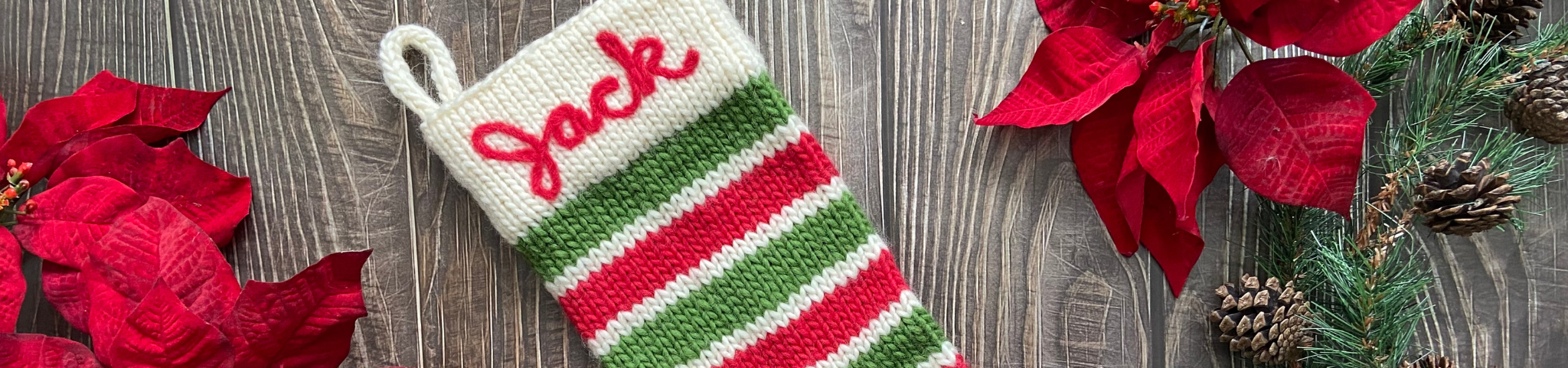
Knit a festive Christmas stocking in classic holiday colors for a vintage feel—or customize it with your own palette to match your style. Personalizing the cuff is easy and fun using a simple needle felting technique—it’s just like writing with yarn! Click here to download the free pattern.

Download free pattern

Share tips, start a discussion or ask other students a question. If you have a question for an expert, please click here.

Make a comment:
characters remaining

No Responses to “Striped Christmas Stocking”

No Comments

Hi everybody, welcome to our live knitting event. My name is Brenda KB Anderson. I'm a crochet and knit designer and also an instructor, and I'm very excited today to show you guys how to make this stocking. So when I was coming up with a Christmas theme party, because you know we're celebrating Christmas in July here. Um, I really wanted to do something, you know, kind of go back to the basics and also make something that had a really vintage feel because I have a lot of really fond memories of being a kid on Christmas and I just, um, kind of was falling back on those memories and thinking about that when I was designing this project, so I wanted to use some colors and some nice bold stripes, and then of course the name on the stocking personalized.

My mom had made all of us kids' stockings and we all had our names, uh, embroidered on the top of them. Um, but one thing about embroidering on knitting or crocheting or otherwise bumpy fabrics with holes between your stitches, it can be really challenging to make it look really neat and tidy. So I have a different, an alternative method here. Um, we're not really using, we're not using embroidery to put the, the name on. We're going to be using a technique called needle felting.

So we'll get to that towards the end, um. But this is such a great technique to use because you, you know, it doesn't matter how many, it's not like it's color work or anything complicated like that where you have to plan it all out. You're basically like drawing with yarn or doodling with yarn and attaching it to your piece with this little barbed needle as you go so it just really takes the stress out of personalizing it with, uh, with the name at the top. It just makes it fun, you know, you, you can. Put any name, any combination of letters, doesn't matter, you know, as long as you can fit it there, you can make it work.

If it's a really, really long name you could switch down to like a thinner yarn so you can get a little more detail, um, but there are just, you know, ways to customize it so you can really write anything on there. All right, well, I'm glad that you guys are here. If you guys have any questions about what I'm doing or if you have any helpful tips or suggestions for other knitters, um, or myself, I would love to hear them. You know, definitely put those in the chat. um, also if you have any suggestions for future events for either stitches you'd like to learn or projects you are interested in making, put those in the chat as well.

Um, yeah, I, I, I am excited to hear from you. Or if you just want to tell me where you're knitting from or, you know, just anything about yourself, I always love to hear from you guys. All right, so let's talk a little bit about the materials you're gonna need for this project. So for one stocking, it's fairly, in my opinion, it's fairly large, but I feel like as I've gotten older, I keep seeing the stockings get bigger and bigger which just seems like, uh, they're gonna be so hard to fill. Because I always thought of stocking stuffers as being little things, but this, this to me is a pretty standard size, maybe a little bit bigger than, uh, I had when I was a kid, um, size stocking.

let's see, I can tell you. it's about 12 inches in circumference and about 19 inches from the top to the bottom, ok, not including the cuff that goes to the inside or, or the loop. Um, so we're gonna need 3 skeins of yarn, and I do have the exact yarn that I used. I put a link in there in case you can't find it. Um, it's fairly inexpensive but really, really lovely wool.

Here's the thing about this project: in order to do the, the personalization, the name at the top here, or whatever you're writing at the top. The yarn that you're using to create the word and the yarn that you're placing it on, so in this case it would be that off-white color. Both of those yarns have to be able to felt. so typically we use a wool for that, but it could be alpaca or some other kind of animal fiber, but just make sure it's not a washable wool. If it says washable wool or super wash or anything like that indicating that you can wash it in a washing machine, it's not gonna felt because it's been treated to not felt, and we want it to felt, so, um, that is essential for doing the name on here.

now, if you just have some yarn that you wanna use, you don't wanna use this technique, you could certainly embroider it on there or do some other, you know, some other type of way to get the name on there. But the way that I'm teaching this class, and, um, the needle felting technique, you will need to have both of those colors be a feltable, uh, a feltable yarn. uh, this yarn is a chunky weight yarn. It's also a one-ply, but that doesn't mean you don't have to use one-ply. That's just the yarn that I picked out.

I found that it was very easy to make that kind of yarn felt. I also mostly picked it for the look of it, the appearance of it. I just liked how it looked. Um, so this is a surprisingly soft wool. It's got a lot of body to it, so I don't mean soft like drapey, it doesn't have any structure.

It does feel like it has a bounce and a structure that is nice for keeping the stocking in shape. Um, but you could certainly substitute with something else. You can substitute with acrylic, um, or some other kind of fiber blend as long as you are, um, not going to be doing the needle felting at the top. Otherwise, you gotta use wool or alpaca or something that's going to felt. OK, so we need three colors: the white color in the stocking, that's what I call the main color, and then we have color 1 and color 2, I think.

Let me just double-check and make sure that's how I labeled them. Let's see. Contrast color 1 is the green, and contrast color 2 is the red. OK, so this is contrast color 1, contrast color Um, and then I only needed one skein of each of these colors for my stocking. However, I only had a small ball of the main color left over when I was done, so I would suggest getting two balls just to make absolutely sure you're not going to run out.

Or, um, since that does add to the cost of this project, if you want to instead for a little section on the inside, so we have like a little self-hem piece here so it's nice and stiff at the top and it hides what happens on the back when we needle felt this and it looks very neat and tight. In here, if you want to do a section in here, you could create this with either the red or the green because there's plenty of red or green left over after you make this project. So you can start with either red or green and work about maybe 10 rounds into it and then switch to the white and then you would for sure have enough of just, you know, using those three skeins of yarn. I do have the exact yarn amounts you used, all that stuff is available. It's included in that download.

All right. Oh, which, by the way, there's a link for the download. It's free to everybody, and I highly recommend this download because, well, not only does it have all the instructions that you're going to need, but also I put a whole bunch of pictures in here of anything that's kind of tricky. Like we're going to do a little bit of color. Changing and it's actually not as tricky; it's not tricky, but it may be something you've never done before.

So in order to have jogless stripes, I used, like, made a photo tutorial, explaining how to do that, and I also did a photo tutorial on how to pick up your stitches around the heel. So, um, we'll get into all of that in this, in this, uh, live event, but if you need any more details, I am gonna be going through things a little bit quickly because there's a lot to cover. So definitely check out the download. There's more information in there. OK.

So, um, so you need the yarn. The needles I'm gonna be using are, let me just double check here. Yeah. So, they're, uh, a size 9, a US size 9, which is a 5.5 millimeter needle, double point needles used throughout. It's just this one set of needles and you'll need 5 of them.

I really like using bamboo or wood needles when I'm working on double points because I, um, especially if you're newer to knitting on double point needles because they have a they're a little bit more grippy than the metal needles or the plastic needles and they won't just accidentally slide out as easily, uh, which can be a very frustrating thing about double point needles. You can also use a different method if you like. Um, you can use the magic loop method, you could use to, to, um. You can use 2 cable needle, not cable needles, uh, circulating needles, sorry, 2 circulating needles of the same size if you prefer using that method as well. Um, you know, it's up to you, but I just like using the double point needles and you'll need 5 of those.

Um, and then other than that, you're going to need the needle felting tool and something to needle felt into. So I'm using this brush, but I really like using those wool pads, and I'll tell you a little bit more about that when we get into the needle felting. This is a needle felting tool. There's a sharp little barbed needle that's right here. It's tucked away inside the handle, and we'll pull that out later.

I did link to my favorite needle felting tool in the download if you want to check that out. That one I don't have with me today, but, um, that one, I just really, really like how that one works. So, um, OK, so let's, let's get started here. Um, you're gonna start by casting on 44 stitches. And you can use whatever cast on method you like.

I particularly like the, uh, twisted German twisted cast on, which is what I'm doing here because it allows for a little bit of extra stretch, and this cast on is actually going to be down here on the inside of the stocking, so I didn't want it to restrict the stocking at that point. Didn't want it to seem like it's tight across here. If it were up here, it wouldn't bother me as much, but it's gonna be down here on the inside, um, so that's why I chose this cast on. If you need a little bit more help with that, we do have German twisted cast on, um, uh, videos on the The Knitting Circle website if you wanna check that out. Um, but this, I've got 4 more stitches to cast on.

I've got the yarn ball yarn and this, uh, right here, and then in front I've got the yarn tail and you're going to want to start with about 2 yards, um, make your slipknot, and then place that on your needle and then to do the German twisted cast on you can hold it in the slingshot position and tip your needle underneath the loop and over the top and grab that. And then we're gonna go over the top of this and pop through that little tiny triangle right there, and then we're going to let that go with our thumb. So we're casting on 44 stitches. Right now I've got 41. 42.

I'm 44. And I, usually when I do this, if I can fit all of the stitches on one needle, I just cast it all into one needle, and then I divide it after I'm done. And we're gonna divide this so that we've got 11 stitches on each needle. So 1, 2, 3. Four, 5, 6.

7, 8, 9, 10. 11, and then I'm gonna take my next needle. One, two, three. Four, five, six. Seven, eight, nine.

10 and 11. One, two. Three, four, five, six. Seven, eight. Nine, 10 and 11.

I'm just gonna double check and make sure I have 11 on this needle. Two, four, six, eight, 10, 11. OK, I do. So there's, um, we wanted to have a little bit of extra yarn tail here in order to use that later to stitch the self hem in place, um, but, you know, you can always add extra yarn in case you didn't leave enough. But that's why I have kind of an extra long yarn tail here to begin with.

So there's lots of different ways to join and start working in the round, and we're gonna do it, in my opinion, in the simplest way. So we're gonna place. Especially because we don't, we don't need to be too worried about having a jogless joint or anything like that that happens because this is down inside of the stocking, so we're just gonna do this the simplest way. So we've got four needles here and you're just gonna check and make sure this is not twisted, OK? So like if this was twisted, you could see it look, it would look like this, there would be like kind of a lump there.

So you just got to make sure nothing is twisted, just kind of lay it in a square shape. And I've got my yarn, uh, my yarn tail here, and then the yarn that's connected to the ball. Right here. So I'm gonna bring that back behind this needle. Here.

And then we're going to just, I'm gonna grab my fifth needle, and then we're going to just start knitting. So I'm gonna do 14 rounds of knitting before we do anything else. Um, but don't worry, I'm not gonna do all that here. I just wanted to show you how I kind of get this started. So because these are all just sort of dangling, if you've never worked on double-point needles before, this is why I really like the bamboo needles, um, versus the metal or the plastic just for double points because they really seem to be a little bit more grippy, and they'll stay in place.

So once you knit all the stitches on that one needle, you've got a new free needle, and then you'll switch to the next to knitting across the next needle. And whenever you're starting on the next needle, make that first stitch nice and tight, really, I'm pulling on that pretty hard with my finger here. So that we don't get those ladders or those gaps between where our stitches are and one needle from that, from one needle to the next needle. And the first couple rounds is always the trickiest because it just feels like everything's dangling, and it's a little bit awkward, but once you get a couple of rounds in, it does get quite a bit easier, so don't worry if this is the first time you've ever done it. Um, you know, it does, it does get easier; it will get easier for sure.

So I just kind of take your time as you move to the next needle to sort of readjust things. Make sure nothing's twisted, or you're not getting caught on or you didn't grab the opposite end to knit with. OK, so we're just knitting all the way around. And we're gonna knit 14 rounds, and you can place like a locking stitch marker at the beginning of your rounds if you like. I normally don't do that because I always have this little yarn tail here to remind me that this was the last this is the end of my yarn or end of my round, or the beginning of the next round right there.

So I know where, um. Every time I pass that, I know that it's been another round. So you're just gonna keep knitting around until you've got 14 rounds, and your piece will look like this. Here we are. So we've got 14 rounds of knitting, and then we're gonna switch to purling just for one round.

So we're gonna bring that yarn in front. And then purl one round. And then we'll go back to knitting. So this purl round is just here to help your cuff know where it needs to fold. This purl round will become the very top edge of your stocking, and it just it's kind of like it just creases it in that one little, in that one little, um, line around, if that makes sense on that.

It's gonna be making the top edge of your stocking. So I'm just purling all the way around. See how it makes that bump on the front, that, you know, pearl bump, and that's going to allow it to fold to the inside. So we're going to pearl all the way around and then we're going to switch back to knitting and we're going to knit 15 rounds after our pearl round. So there'll be 15 more rounds of knitting.

And our piece will look like this, and you can see that little pearl bump there. That's what's gonna allow it to fold right there. That's gonna be the top of our stocking. It just looks really neat and tidy and it gives us, um, when we're later when we're doing the, the personalization, um, the needle felting, it'll give us a nice space to look at to know that our words are going to be right, right there. OK.

So now we're gonna start working on the stripes. So after you've done your 15 rounds after the pearl bump, OK, so we've got 15 rounds of knit. We're gonna switch to color number one. Which is the green. In my case, we've got lots of hellos here you guys.

Oh, thank you guys so much for popping in and saying hi, Mary, good morning to Mary and good afternoon from Austria. Sandy, hi. And there's a Brenda here. Hello from Kentucky. Hi Brenda and Deborah, hello from Idaho and Dawn, I recognize you, Dawn.

Hi, Dawn. Um, and, oh, Sandy says it really has a very vintage vibe. Oh, thank you. I'm glad that came across. Sometimes, you know.

When I design things, I feel like, am I the only person who thinks this about this project? I guess we'll find out. And before I used to do live events, I, I, I for many years I designed for um magazines and yarn companies and things like that, and I really wouldn't get that much of a response because I was never doing live events or interacting really with the people who are making my patterns except on Ravelry. Sometimes I would get messages from people on Ravelry, which was always exciting. So it's, it is nice to have these live events and actually be able to talk to you guys.

Oh, Brett's mom's here. Hi Brett's mom. And thank you for the compliment, Claudia. We've got, and uh, a love eye emoji from Josie and. I really like the circular needles for this better, OK.

Yeah, for a lot of people, they're gonna want to use the circular needles. I really, for this particular project with this grippy yarn, the double-point needles for me worked really well, but I, definitely understand using the circular needles, the circular needles, or the magic loop. Oh, we got a magic loop girl here, Erica. OK, so let's talk about how to switch from one color to the next. Now, usually when I do jogless stripes.

I usually just slip the first stitch and just knit all the way around and then keep knitting, but that method works OK. Um, I did that method here at the very top of the stocking and then later I was like, I think I want to try out a different method, and I switched it to down here to a different method, which is the method I'm going to be showing you. This method I feel like is nice and flat and it you don't get that issue where you have one fewer stitch um. When fewer round or whatever of like you'll always have one fewer stitch there because you're slipping a stitch if that makes sense, which you can kind of see here which that was the thing that was bugging me was because I was doing such a thin little stripe of the white and then I thought, OK, I'm gonna try a different jogless striping method, which I did down here and I was so happy with it, um, and I'm excited to show you, show it to you guys. This I feel like is maybe not as common, but um, I don't know, you guys could tell me, maybe you've already done this one before.

So, in order to switch to the next color, you finish up your previous round, and then you take the very last stitch that you knit and you're going to place it back, slip it back onto the left-hand needle just for a minute, OK? So you're just going to slip it purl-wise. Then we're going to take our, the color that we're going to start working in, which is the screen, and I'm going to make a little sort of like a little loop here. I've got the cut end on the bottom and the long end that's attached to the ball of yarn on the top, OK? So then I'm going to place that on my needle here.

Like this. OK. So again, this is connected to the ball of yarn, That's sitting on top of my needle. The strand that comes underneath the needle goes to the back, that's just my cut end. All right.

So, we want to leave a little bit of a yarn tail here so we can weave that in later. So, we're just gonna leave that there, and then we're gonna slip this stitch back to the right hand needle like that. And now we're gonna get ready to work with the green. So, we're dropping the white color, we're gonna pick up the green color, and this feels wrong at first. The first time I did this, I thought, how can this be?

It's just barely sitting here, hardly doing anything. I just didn't really trust it. But it actually works really, really well, you guys. OK, so I'm kind of hanging on to this yarn tail in my hand. You probably don't for this project because this yarn is so grippy, you don't need to worry about that too much.

And then I'm gonna go in here and just go ahead and make a knit stitch with that new color like this. And then just continue knitting. So, I'm just knitting in that new color, and you can see what happened on the back. Here's where that loop is. It just kind of, kind of comes over here, and it looks kind of bad right now, but don't worry, we're gonna fix that later.

That's just how you start it. So, we're gonna go all the way around with this new color. Just knitting all the way around here. We've got a hello from Rosa from Fresno and hello from Massachusetts. Oh, we got another Magic Loop girl, Cathy.

With the short circular needles, the Crazy Trio from Addi work on the stocking. Oh, I don't know. I have used them. Some very short circulars, yeah, you can, you can definitely get short circular circular needles. I think I have a 10 inch pair, um, and that would definitely work.

Um, but when you get a little closer to the, like when you start working on the, the heel and the toe, um, that might be difficult to use those shorter circular needles, so. Um, you're gonna have to switch over to double point or some other version of 22 circular needles or magic loop or something to finish that up. So part of the reason I recommended the double point needles was really just so that if people had to buy needles they'd only have to buy one set and it would be easy, um, but yeah you just there's, you know, with knitting, there's always a different way to do things and people have different preferences and definitely just do whatever feels like the right thing for you, the way that you like to knit. OK. So, I am almost all the way around, and I'm gonna show you that weird little spot where I laid the yarn down.

So we've got a couple stitches away, and you can see that kind of funny loop happening there. So I'm gonna knit the last two yellow, yellow last two white stitches or main color stitches, and then here we are at this place where there's a green and the main color, which is the white. Those are the very last two loops on there, and we're gonna knit them together. So I'm just gonna come over here. Knit those together.

And then I'm going to pull on it, kinda got a little bit loose here, and this happens sometimes. I'm just going to pull on that loop, that beginning tail to tighten it down a little bit and pull on the main color tail as well, OK? And now we're ready to just continue knitting around. So I'm going to knit one more round and then I'm going to show you what this looks like. So I know that there are other ways of making jogless stripes.

Um, but I was happy to find this one because if you're doing narrower stripes, you know, not so many rounds in each stripe, it really seems to make it a little bit more seamless. So, um, yeah, this was a, a new technique to me. Uh, I had, I never used it before, so I, I was very excited to try it out and have it actually be. I, I just feel like it looked better than the other technique that I was using, so. So in this stocking pattern you're going to be the all of the colored stripes, so like the green and the red stripes, those are all 5 rounds.

So you'll work 5 rounds and then you'll switch to the white and then you'll work 2 rounds in the white and then you switch to the red and work 5 rounds in the red, switch to the white so. Every time, you know, there's always a thin white stripe between each of the colors and the red and the green are always five rounds. All right, I'm coming around to the end here. That's the end of my round. So, um, I want to just show you what that looks like.

Let me tuck this under here. So because we pulled on this little yarn or this beginning yarn tail, that kind of straightens out that jog and it makes it look like it continues from one side to the other. When in actuality, you know, it's always shifted when you start a new round, um. When you start, here's the green and then it ends up like on top by the time you come around. So that's why it always has that sort of jog and color, um, but because we have this little yarn tail tucked underneath the strand, we are able to pull on that and it basically forces it to align across that, you know, the beginning of the round so that it looks like it's an even stripe.

So let me just show you this again so this. This direction, this is what it looks like right here. That's where our jog is. I mean, you can see it a little bit, but it's much less visible, you know, we've got two stitches in the white here, it's much less visible to me to look at this as compared to this where we just have like that one stitch in the white because I slipped my stitch. At the beginning of the round.

That was a different technique. So this is the technique that I'm using here. All right, so, um, but if you have a different technique that you prefer, you know, definitely do that. There's always room to switch things up and customize it and do it your own way, right? And knitting?

Um, OK, let me see here. Oh, we've got a hi from Munich in Germany. Hello, welcome. OK, so after you do your five rounds, then you're gonna change to the white and change in the same way and work two rounds in that and then go back to the red and you're gonna be striping back and forth. Let me show you what that looks like here.

Um, OK. So this is a stocking in progress. I just ignore the top here. We, we have not gotten to this yet. Let me just fold that underneath to you guys.

We'll just pretend that's not there. So as we're working up the stocking, we're gonna go green, white, red, white, green, white, red, white, green, white, red. OK, so there's three repeats of the red, three of the green. And then we're going to place a little bit of waste yarn here. We're gonna knit some waste yarn here, and then later on, we're going to remove the waste yarn, pick up those stitches, and then knit the heel later on.

So, I'm gonna show you how to place that waste yarn to do this heel. Um, and here is, so this little sample, actually, let me pull this back over here so I can kind of orient you on what this is. Um, so. This is what you should have, you know, right before you start the heel. You should end with that red stripe there.

So that is what I'm showing you here. We're just pretending this little loop is this section of our stocking, OK? And now we're ready to get ready for that heel. So I'm going to show you the color change one more time. Because we're changing to white, we're just doing one round in the main color.

All right. Oh, and I did want to talk a little bit about carrying your yarn, so. With stripes, you can decide for this project if you want to carry your yarn up and let me show you, let me see. I think I left some of it unstitched so you guys can see what this looks like. Here we go.

So what I decided to do was I carried my white yarn up but I did not carry the colors and the reason that I did that was because the white yarn, uh, um, there isn't as much space between one white stripe and the next as opposed to one red stripe and the next. That's kind of a larger amount of space. So I didn't carry my yarn for the colors like the red and the green, but I did carry the white yarn. Now you can decide if you don't want to do that, you, you, you can just, you know, cut it off after every round, um, you know, and join new, but what I did was I carried the white yarn all the way up and then I used these extra little yarn tails of the color and as I wove these in I kind of stitched over that carried yarn to secure it so there isn't a big loop so nobody can get their fingers stuck in there when they're reaching into their stocking on Christmas. Morning.

Um, so you can see here that I just sort of stitched over that, so that's something to think about. It made it really easy for me. I didn't have so many ends to weave in because I was just carrying that white yarn, um, and I'll show you, I'll show you here what I mean by that, if you've never done that before. So, I've already done a stripe in the white here, and I still have my yarn ball attached. I'll show you.

OK, so I just dropped it. When I switched colors, I just dropped it and let it hang on the inside or on the backside of, of my work, and then, I picked up the red and started knitting with that and now I'm going to switch back to the white. So to do the color change, if your yarn ball is connected, it's the same thing. So you'll just slide your last loop that you worked in the last color um of the last round, last color, and now we're switching to the new color. And now we're switching to the new color.

And then we're going to grab that main color that we were carrying, and we're just going to bring that up. And bring it to the front of our needle and up over the top of the needle. OK, so this is the yarn ball connecting. It's going up over the top like that. Then we're going to switch, uh, then we're going to slide that stitch right back to the right hand needle like that, and this is just hanging out here.

So, now we can grab that and we're gonna start knitting with that. So we're gonna give that a little bit of a tug there. So we're starting out, we don't want there to be a gap, but you can see there's my little yarn over that I did. That was the last stitch and we slipped it back and then we just started knitting with that main color. So we're gonna do a round in the main color before we place the waist yarn for the heel.

Oh, thanks, Sheila. I was just reading your comment. Uh, they haven't knitted in years, but they're looking forward to getting back into it. That's awesome. Oh, you've been quilting for a while.

Oh, so my mom is a really big quilter, and I think she's always had the secret hope that I would turn into a quilter too, and I've, she taught me how to sew way back when I was like 4 years old and I've been most of my career since, um, yeah. Since my early twenties, I worked in a costume shop, so sewing was a very very big part of my life. I've always made garments and costumes and that sort of thing. So it's just like one shade away from quilting. Um, and in my next live event, which is later on today, I'm going to be doing a live event where I'm teaching people how to make a, a pillow that's actually crocheted, but it looks like it's quilted.

It's got, um, like those tri I don't, OK, so I'm not a quilter, so you guys who are quilters are probably gonna laugh at me, but I think it's like when you have a square but it's divided on the diagonal and one side is a triangle or like one color of the triangle. The two triangles that make up the square, we've got one color on one side and one on the other side, so I'm gonna teach people how to make those and how to put it together to look like, um, I believe the quilt pattern is called the Crystal Star quilt pattern. So that's going to be my next live event that's happening later on today, um, at 11:30 just in case anybody wants to watch that. But I showed that project to my mom and who's, you know, very excited about quilting and I think she just kind of got that hell moment of, oh, OK, maybe she is going to turn into a quilter after all. I feel like I'm just baby steps away.

I don't know why I'm resisting. Mostly, I think I'm just afraid of the fabric stash that's going to, that would probably happen. OK, so I came all the way around and now I'm at that weird little spot where I've got the yarn over of this new color that I've been knitting with here and the old color together. So now I'm going to, I'm going to knit them together. And just drop them off the needle.

And I'm going to pull on that red yarn tail to tighten that just a little bit. And there we go. So that will create our jogless, uh, stripe. And now we're ready to begin pla um working up our waist yarn here. So let me grab that.

So this could be, this is just the worst weight acrylic yarn that I'm using here for the waist yarn. Um, oh, I forgot to mention we needed this when I talked about materials. So this is just, you could just grab whatever from your stash, Just find something that's not super sticky, because we're going to be removing it later. Uh, and it should be something the similar-ish weight, but it really doesn't have to be perfect. So I'm going to be placing this on my project so that it's just hanging out here on the front.

So I'm putting it between my two needles and I'm just going to knit across the first two needles, meaning half of the circumference or 22 stitches, just going to knit with this new little strand of waste yarn. So, this is basically just kind of setting aside some loops that we're going to pick up later when we create the heel. So, you'll knit all the stitches on the first needle, so that's 11 stitches, and you'll knit all the stitches on the second needle, which is 11 stitches. And if you, if you are using a circular needle at this point, or some other way that's not double point needles, you'll have to slide all those needles back or all those stitches back over so that your, um, beginning so that you can begin your your two needle tips are over here again because we're gonna go back to where we first started knitting all of that waste yarn. Oh, I'm just going to cut this off.

Just need about, you know, 6 to 10 inches or so, and we're just going to let that hang out on the front of our project, both strands. And now we're going to grab that. Main color once again, and we're gonna knit all of the stitches in the round. So, I'm gonna be hanging on to this waste yarn that's sitting on the front because it's not really attached to anything and it'll just sort of loosen up and pull out, and we're gonna just go ahead and knit across all of these. All of these waste yarn stitches.

Like that. And knitting across the second needle of waste yarn. So if for some reason you wanted your stocking to face the other way, So, um, what I mean by that is like, say you already have some other stockings and you want them all to be lined up so the toes are pointing the same way. This is really the front of your stocking. The joins or the beginning of the rounds are happening back here on the back of the stocking, but if you wanted the toe of the stocking to be this way and the heel to be this way and this to be the front, um, if you care about that, then you can place this waste yarn on the 3rd and 4th needles instead of the 1st and 2nd.

So this only pertains to you if you don't like the way that the stocking is oriented. This just occurred to me that some people might like. They have a specific way they want their stocking to hang, like everybody else has their stocking hanging to the left. Maybe you should too. Um, OK, so we're continuing with that main color yarn, and I'm just gonna be working across the 3rd and 4th needles to the end of the round.

OK, so we worked across the two waist yarn needles and now we are working. The last two needles in the round. Just knitting everything. And here we are at the end of the round. So at this point you would switch to the next color, which would be green, and then you would continue knitting, um, knitting your stripes.

You'll go right back into the same pattern we've been working. So 5 rounds of green, 2 rounds of white, 5 rounds of red, 2 rounds of white, um, and then you're gonna end with 5 rounds of green, and then I believe it's. one or two rounds of the white, I can't remember before we start the decreases. Let me check. 79, yep.

So two rounds of white. So you're gonna end with two rounds of the main color and then you're gonna start your decreases to shape the toe. So I already have those in progress here, and I'm gonna show you how to do them. So after you've worked those two rounds in the white, then you're going to start doing your decreases. Oh, here, let me just show you what this looks like, by the way.

So here is our little waist yarn section that we put in there, and then we continued working up the rest of the toe right here and now we're going to be doing our decreases. So, I've already started those decreases, but this is how they work. Um, you're going to start out with a knit two together, so you're just going to place your needle knitwise through these two stitches, and you're gonna knit them just like they were one stitch. So we have a knit two together right at the beginning, and make sure that's pulled nice and tight. And then you're gonna knit all the way across the rest of that needle.

And then we've gotten to the needle #2. So we're gonna knit until there are only two stitches left. And here's my two stitches, then we're gonna slip, slip, knit. So we slip it as if we're going to knit it. So we come into the left side of the stitch and pull it off the needle.

Same thing with the next loop. And then we're gonna knit that through the back. So slip, slip, knit. All right, and now we're gonna do exactly the same thing on this side of the sock. So we're gonna start out by knitting two together.

Make sure you make that nice and tight. Anytime you switch to a new needle, make sure you really tighten that up. All right, here's the next needle, and we're gonna knit all the way across until two stitches are left. Here's those two, and we're gonna slip that knitwise, slip the next stitch knitwise, and then we're going to knit through the back loop. So that's a slip, slip, knit.

Like that. All right. And so, after you do your first decrease round, then you work one round even, meaning you're just knitting all the way around, then you do another decrease round, you knit all the way around. So you're kind of going every other round, you're doing decreases, and then at, um, about halfway along the toe, you're just going to start decreasing every single round until you have, let's see. eight stitches left.

OK, so when you only have eight stitches left, so that would be two stitches on each needle, total of eight, then you're just going to cut your yarn tail, use a yarn needle, and run it through all of those open stitches and pull that tight to close the toe, and then you can run that through a couple more times just to make it really sturdy and kind of fill out those loops a little bit. And your piece will look like this once you've finished it up. Now this is not a normal way to finish off a toe of a sock, but I was just avoiding the kitchener stitch. I was trying to keep this a little bit more beginner friendly, and there are lots of other techniques that we're talking about in this, um, in this particular, uh, project. And also this is not going to be worn by a foot.

Also, P.S., I mean, most likely nobody's wearing this. Although I liked to do that when I was a kid, I used to put my foot in my Christmas sock. Um, so it could, you know, I just wanted to kind of finish it up with that little easy little ending, weave in my ends. Then you've got to go back and work on the heel. So let me show you how to do that.

So in order to start working on this heel, first we're going to place our needles. Into our stitches before we cut the yarn out, so. If you're looking at, oh, so I have this, with the toe pointing in this direction, this is the cuff direction pointing towards me. So I'm going to place my needle underneath the right leg of each of these loops in the main color that you can see here. So I'm gonna pick up 11 here.

1, 2, 3, 4, 5, 6, 7, 8, 9, 10, 11. And then I'm gonna use my next needle, pick up 11 here. So, still picking up that right leg, 2, 3, 4, 5, 6, 7. 8, 9. 10 and 11.

OK, we got the next needle in. Now I'm gonna rotate this so the toe is pointing at myself. I mean, you should have finished off your toes so you won't have all these needles, um, facing you. All right, and then we're going to pick up. Let's see.

That one. We've got 11 stitches here, so we're gonna pick up. So I split my yarn a little. 1, 2, 3, 4, 5, 6, 7, 8, 9. 10 and 11, and then we'll pick up 11 here.

Picking up that right leg of the loop. 1, 2, 3, 4, 5, 6. 7, 8, 9, And 11. OK, so you should have 11 on each needle here. And then we're gonna go ahead and cut.

The waste yarn. So just be careful when you do this, you're not cutting a loop of the main color. You can also just, if you're worried about that, you can also just sort of pick it out. You can cut it off really short here and you can just use another needle to sort of unravel it here like this if you're worried about cutting it. I usually end up cutting it in a couple of places because it seems like so much to pick out.

Um, but you have to be so careful when you do that that you're really only cutting just that waste yarn. We're gonna pull that out. Don't worry, it's gonna look like a big gap when you do that on the sides, but don't worry. Don't worry. All right.

Getting close here. All right. Thank you guys for being patient. That took me a little bit longer than I thought. It was a little bit tangled in there.

OK. So now we have this opening in the back of our sock, and that's where we're gonna, where we're gonna put our heel. And the good news is you guys already pretty much know how to knit the heel because it's very similar to the toe where we just do um decreases, only we're not going to do any rounds where we're working even except for the very first round where we're just joining our yarn and knitting around and I'll show you that. Let me grab a new ball of yarn here. OK.

OK, so to knit across our our heel, we're gonna be starting, so the toe is pointing away from me, right? We're gonna be starting by knitting across the very bottom edge, this bottom opening here. There we go. Um, and when we do this, we're going to be picking up a couple extra loops. Just so that we don't have a gap here at the corner of the heel, OK?

So, um, before I knit across, I'm gonna use this bottom needle to pick up. Let me see if I can pull this out of the way. There are really good pictures of this in your download in case you are having trouble understanding what I exactly I'm pointing to here, but this stitch and this stitch in the main color white right there and right there, we're going to pick up the right legs of each of those stitches. So one here. And one here.

And then we're gonna go ahead and just join our yarn by knitting. So I'm gonna just leave that yarn tail on the outside, hanging on the outside, and then I'm gonna go ahead and just start knitting across. So we're gonna knit across those two little stitches we picked up. We're gonna knit across all the rest of those stitches where we had freed them from the waste yarn. So we've got a total of 13 stitches now on this first needle because we picked up those 2 stitches of the main color in that stripe.

All right, so we've got our 13 stitches here. And we're gonna move to the next needle. And we're gonna work across these 11 stitches, and then we're gonna pick up 2 more at the end. OK, so we've knit across the 11. Now, we're gonna pick up two stitches right here in this main colored stripe.

OK, we're gonna pick up the right leg here and the right leg there. We're just gonna go ahead and knit those. All right, now we're going to rotate our work 180 degrees like this, and then we're going to knit across these two needles that are across the bottom of the foot. So we're going to do exactly the same thing that we just did, except we're going to pick up, we're going to pick up those two main color stitches right from that stripe, OK, just the right leg of each. And then we're gonna knit across.

So right now, we've got 13 stitches on our needle because we picked up 2 in that little main color stripe. So we're gonna knit across those 11. Just like that. And here we are with those, the last 11 stitches, the last of the 4 needles right here. And we're gonna knit across all 11 stitches, and then we're gonna pick up 2 at the end.

So, 123. For 11, and then we're gonna pick up two stitches. In this main color stripe right here. All right. Pick up one there and one there.

I almost knit with the beginning yarn tail, you guys caught myself just in the nick of time. OK. So here's our last two. Stitches that we just picked up. And so now, we've got 13 stitches on each needle, and we are well, well on our way to just working in the round, decreasing, so we would start.

Um, decreasing our heel, we would do a knit 2 together here, knit across that needle, knit across this needle until there's 2 stitches left, slip, slip, knit. Then we're going to turn, repeat, knit 2 together, knit across, knit all the way across till the, there's 2 stitches left, slip, slip, knit. So this exact. Exactly the same stitch pattern that I just showed you where we were decreasing the toe, only there's no rounds where we're just, um, besides the one we just did where we picked up those stitches, every round is a decrease round. So we're decreasing 4 stitches per round until we get, I think it's still 8 stitches left of the heel.

Let's see. Yep, 8 stitches. So we're gonna do the same thing. You'll cut your yarn, run it through the remaining 8 stitches, and close up that heel. So that part is finished, and now I want to show you how we personalize the stocking.

Ok, so I'm gonna open this up. it's a little awkward with all these needles down here, but I do want to finish this sock later, so I'm just gonna leave them in there. Um, and here is the top of our sock, and so you'll see we've got that join. This is the beginning of the rounds; it should be right centered in the back of our sock. I mean, once you get the heel in here and the toe in here, you're gonna know what what you know what's the front, what's the back of your stocking.

So in order to do the needle-felted section, you can place your mat or your, your bristle brush thing like what I have here, inside of your sock. And if you're not very comfortable with. um, I'm gonna place it this way a little bit, I think. I just wanna make sure, you wanna make sure you're not stretching out your fabric. So my fabric is a tiny bit stretched, so what I'm gonna do is stretch it across the back.

So that the front where it's going across the brush is not stretched at all. Ok, so it's a little stretched back here. You can see it's tighter here. That doesn't really matter for right now. You just want to make sure this is not stretched out when you put your brush in there, or your felting pad or whatever it is that you have.

All right, I'm gonna grab. My felting tool. And get that ready. So this is a really inexpensive felting tool. It has a little barbed needle.

And the needle has a little L-shaped bend, so when you place it in here, it stays in place. And it just works like that, then you use this little barbed needle to entangle your wool pieces together, to felt them together. All right, we're gonna do. I'll just do, I'll do the stocking for my friend Joe. Um, so if you, if you like, ahead of time, you can use like a wash-away marker, those blue or one of those fading markers that you can use, um, they're in the sewing section at your craft store, and you can trace it out.

You can write it on right on here if you want, and then you can rinse it out later to get rid of the marks. Or what I usually do is I just start by needle felting just a little bit at first. Um, and not getting too crazy into it until I am sure that that's where I want my letters to be. So, um, and you may want to give yourself like, you know, if you have a pin or something, you may want to put that in the middle so it kind of helps you stay oriented with where the middle of your word is going to be. There are things that you can do to kind of help yourself get your, you know, it's like if you were writing something on a piece of paper, you know, you can divide it in half and make sure the center of your word is right there.

Usually what I do is I just start. I just start felting. So you just have to make sure, especially with this brush thing that I'm felting into, that brush that's underneath here, you have to go straight up and down. If you are using a wool felt pad, it's just kind of like a thick felted brick of wool. Those are my favorite because if you go in at an angle, it's not gonna break your needle.

These needles do break, so you know. Just sort of be mindful of that when you're working on it. You may want to even wear goggles if you're worried about that. You don't want anything to, you know, if you're getting very excited about your needle felting, it could fly up. Um, you don't want it to hit you in the face.

All right, so I am doing this in a cursive. Uh, cursive letters, you don't have to do it this way. You could cut little pieces and felt them into your project. You could certainly do that if you wanted to. So I'm not felting it very much.

I'm just felting it very lightly right now. Because I'm just sort of testing out where I want these letters to be. I can still pull this off. Like, it's sticking, but I can still remove it if I want. All right.

And then we'll have an O here. And I want to change directions. So the reason that I'm doing this in cursive, besides that I like, I feel like it looks a little more vintage, you know. Because who uses cursive now? Not very many people, um, but I love it.

Um, but also because it makes it a lot easier so you can just keep using, you know, your yarn. And you don't have to cut all these little pieces, but if you don't want to do it in cursive, that is completely fine. You can just cut little chunks and needle felt them on. Here we go. Joe OK, so once you are happy with where your letters are, how they look.

You can also cut your piece, and I cut that a little extra long because I wanted to show you something. If you are placing, um, just straight lines and you're cutting pieces, it really helps it look nice if you are able to fold it under itself like this. And be careful; you don't want to needle felt through your finger. So, you know, never needle felt right next to your finger. But see how the end, the end where it's folded, it doesn't look all fuzzy.

It doesn't look all fuzzy. Because you kind of fold it underneath and all the fuzzy bits are underneath, you know, you can also just felt and felt and felt and felt until it stops looking all wispy like that. And I know there's probably a lot of people watching this and they're like, Brenda, is that really gonna stay on? I mean, it doesn't really look like it's gonna stay on, Brenda, but it will. You just have to felt it a lot more.

So the other felting pen that I linked to has 3 little felting barbs, 3 little needles, and you can felt a lot faster. I'm also a little bit afraid to felt too fast. Um, into this brush because I haven't used the brush in a long time and I'm very used to using my wool, my wool pads, but I had lent it to a friend, so I don't have it. Um, so I'm being a little extra cautious cause I don't wanna break my needle. But this, you know, it does take some time to really get it felted in there.

So, this one's already been felted, and you can see it is really stuck. You know, you can hear the texture of it, but it's not, it's not coming free. It's really, really felt it in there. And so you're just gonna keep felting and felting and felting until it stops looking quite so fuzzy. Like, see, if you compare these two, I don't know if you guys can tell, but it gets a little more crisp looking as you felt it.

It's going to kind of condense all these little fibers a little bit more, the more you felt them. The more you felt them. It gets, it's right now it feels very fuzzy and I could probably pull off most of this at this point. There might be a little bit of red fuzz on my piece if I did that though, um. Piece if I did that though, um.

But you know, I could probably pick this off. This one I can't pick off. It is really felted in there and it, it will stay like that. Um, anybody who's ever accidentally felted a sweater and tried to unfelt it, it's really hard to unfelt something you really can't. It's really hard to unfelt something you really can't.

All right, um, oh, let me just check and see. Oh, I'm missing. Lots of your comments, you guys. I'm sorry. Oh, half square triangle.

That's what I was trying to think of when I was talking about the quilt, quilting terms. Yes, thank you for that, Karina, 625. Um, fabric stash is exactly why I don't take up quilting. Yeah, I'm a little afraid of that. OK, I thought you'd be able to pull the waist yarn through.

OK, so sometimes you can pull your waist yarn through, but this yarn that I'm using is very sticky, um. So I, you know, if you use a cotton, a much smoother yarn, you might be able to pull it through, but usually you have to cut it in a few places. The yarn that I ended up using today for the waist yarn probably wasn't the best. choice. It worked just fine, but I would try for like a cotton, something that is not fuzzy at all, and you might be able to pull it mostly through or at least cut it in a couple places and then pull it out easier.

OK. Oh, we have a question. Is this a 100% worsted weight wool for the lettering? So this is a chunky weight yarn. Um, it's the same, the red is the same as the yarn that I've been using throughout the project.

It's exactly the same yarn. Um, and it, yeah, it's a chunky weight, 100% wool, and it definitely has to be a feltable wool. So yes, it is 100% wool, um, and yeah, otherwise this process is not gonna work, but you could embroider it or do some other sort of applique or something else to, you know, you could cut out little felt letters and stitch them on, you know, there are lots of other ways you can personalize it if you don't want to use wool. All right, so, um, I'm not going to finish felting this because we're just about out of time here, you guys, but I wanted to show you what the inside of this is starting to look like. You can see how there's a red on the inside here.

That's the, you know, fibers kind of getting poked through and they're getting tangled, and the more you felt that, the more red is going to come through and it's just going to become like kind of a hard line on the outside. After you're done with that and you know that you're finished with your felting. Then you can fold this. On into the inside here, and you can use your beginning yarn tail here to just do a little whipstitch between this edge, and then you can pick up these extra little stitches in the white. OK, so you just do a whipstitch into all of those to steam it down to the inside.

And this will hide that kind of red fuzzy stuff that happens from the needle felting, but also it just makes a really nice, it just looks really finished to have that nice thicker edge up here. And then when you stuff it full of all those amazing Christmas things, it's not going to get all stretched out or look kind of limp. It's gonna be, it's just going to look nice and crisp and you can still read the name. So the last thing, which I won't be able to show you guys because we're out of time, but the last thing is this is just an i-cord here, and you just cast on 3 stitches, make an i-cord for about 9.5 inches, um, and then cut your yarn, run it through the last 3 stitches and pull it tight, and then you just sew it right here to the inside. Of the top of the cuff so that it's kind of sitting on the side that's along where the heel is, and if you've never done i-cord before, we do have videos on the Knitting Circle website that teach you how to make i-cord.

It's a very simple technique to know how to do and it makes a really nice kind of rope-like, um structure there, so that's perfect for a hanging loop. All right, thank you guys so much for being here and for all your comments and just helpful tips and everything that you guys have been throwing into the chat. I really appreciate that. It's always fun to teach these live events and um get a chance to talk to you guys. So thank you guys so much.

If anybody, um, is interested, I do have for Crafty Premium members, um, or also if you are a member of the Creative Crochet Corner. um, if you are a gold member of that, then you'd have access to the live tutorial I'm gonna be teaching on the pillow that I mentioned earlier, so that's gonna be happening in 20 minutes, you guys. So hopefully I'll see some of you guys there. Thank you guys so much for joining me. Bye everyone.

Get exclusive premium content! Sign up for a membership now!