Info Filled Icon
Brenda K.B. Anderson

Visible Mending: The Knitted Patch

Brenda K.B. Anderson
Duration:   1  hrs 16  mins

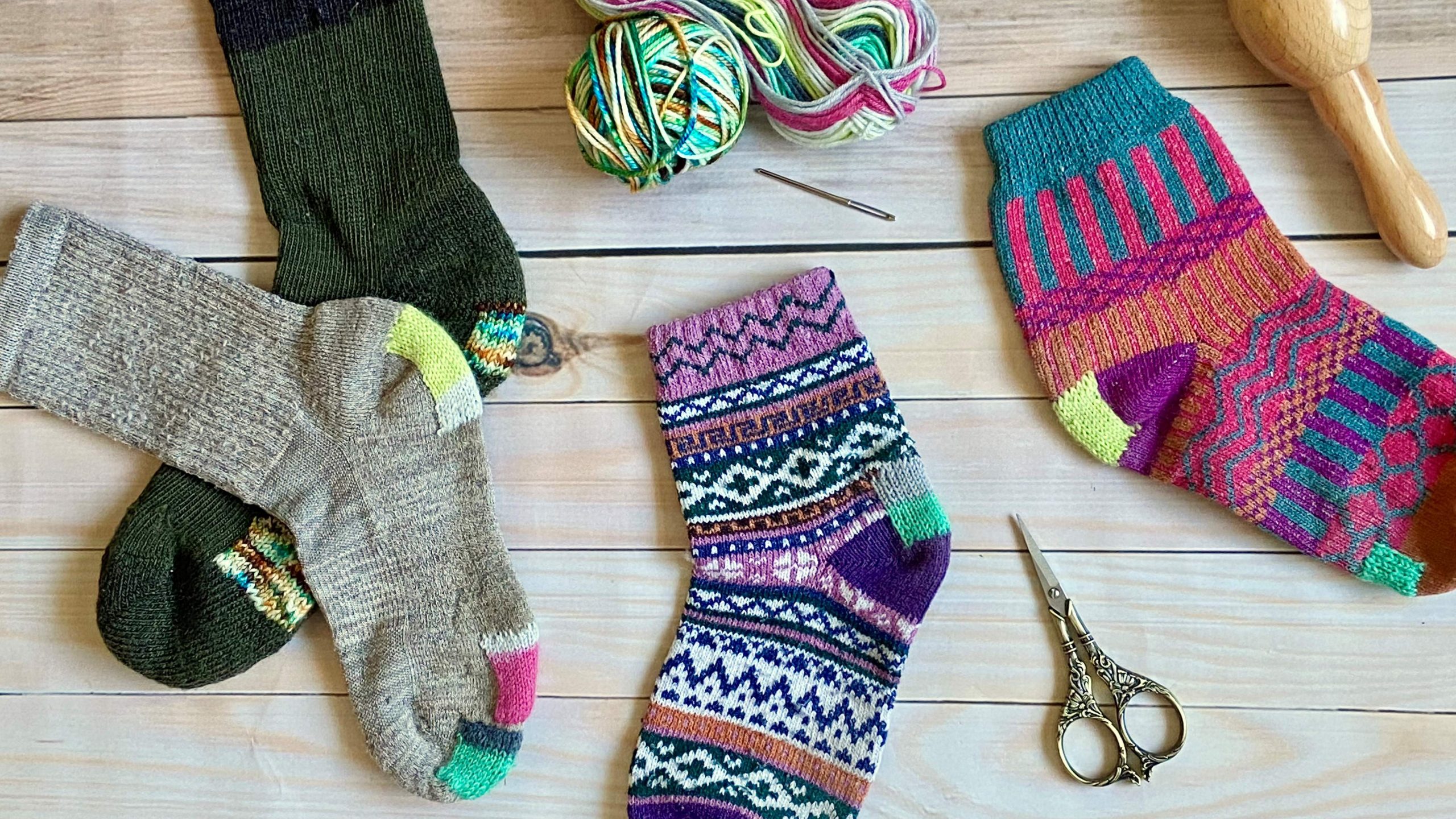
Learn how to mend your knits with this lesser-known technique which results in a knitted patch that is integrated into the fabric as it is made- no need to sew it on later! This method uses a crochet hook to create the knit stitches, similar to picking up dropped knit stitches. Surprisingly, you do not need to have any prior knitting or crocheting experience to mend your projects in this way!

Visible Mending: The Knitted Patch

Share tips, start a discussion or ask other students a question. If you have a question for an expert, please click here.

Make a comment:
characters remaining

No Responses to “Visible Mending: The Knitted Patch”

No Comments

Hi, you guys. Welcome to our live event. My name is Brenda Kaby Anderson, and I'm very excited to show you guys today this technique for making a knitted patch on, you know, it could be store-bought, clothing articles. I use it on store-bought socks all the time. it- or it could be something that you've hand-knitted yourself.

could even be something that you've crocheted, and you wanna put a knitted patch on. there's a lot of versatility in this particular, technique, so I'm very excited to show you guys this. So, I never really mended that many pairs of socks, maybe, like, two or three very special pairs, before COVID. But then when COVID happened, and we were all staying at home, and I was trying really hard to save money, not buy stuff, and, I started getting into m- visible mending. And, and I had always kind of liked that sort of patchwork or adding embroidery to things to cover up little stains or holes or, or, or that s- sort of style.

but I think when COVID hit, it was like I was just full force and finding my basket of all these things that I should have been mending over the years and never really had time, and learning how to do all those types of things. And so I experimented with a ton of different types of mending styles for, specifically for socks. but just know that this, the technique that I'm gonna be showing you, this could be applied- you don't have to be mending socks. You could be mending any, any kind of garment that you, you wanna mend. but I tried out lots and lots of different styles of mending, or, or darning, and, and I've sort of become This one, this one is definitely my favorite for utilitarian, patches on my knitted, knitted socks.

So let me just show you the different styles that I had kind of been experimenting with just so that you have sort of an overview. and I just want you to know, like, it's really worth l- learning a bunch of different ways to do it. If you're into this, if it sounds fun to you, it's really worth learning a bunch of different ways to do it. Because you can combine them together and get different looks, and, the, you know, they have the different strengths. of course, each one has little drawbacks to it, too, and I'll try to talk a little bit about those as I'm showing these, projects.

So when I first started mending socks, I started doing the darning method, where you're basically just weaving into or just above the fabric. You're kind of incorporating this woven patch. you can see here So this sock, this sock is pretty old, and I've already mended it. I'm- this is my second go-round of mending it but this was where I had mended it, and I wore it a lot after I mended it there and here. And it starts, it started to kind of wear down a little bit away from this patch, and this one started wearing away just in this spot here and then under here.

This was a second patch I put on. and so I'm kind of adding more patches on top of this, but this, this style of mending, this is like a, I, It's darning, and it's one of the most common ways of fixing your knitted articles that I've seen. it's, I think, the first one that a lot of people learn, and I think it's really beautiful, and it's really fun because you're actually just doing a mini weaving project. And you can do all kinds of cool things with, having different colored strands going one way versus the other way, which is what I have going on here. That's why it looks sort of checkerboarded, 'cause all of the strands going this direction are pink, and the ones going this direction are sort of a silver color.

and it really gives you a chance to really play with the artistry of it, really, and that's, that's a big component for me, actually, is, not only are you keeping something out of a landfill, maybe you're fixing up something that you really love and have a sentimental attachment to, but also, I, I think of this as just like you're building your own art. I mean, maybe that sounds kinda cheesy, but you, you can see, like, all these different You know, you've had something for a while, and all the little mending scars or whatever you wanna call it, patches and, and that sort of thing, they tell a story, and I just find that to be very special. And I love the fact that you can extend the life of something, you know, f- double it or triple it, you know, before you have to get rid of it. So, so for me, doing this style of, of, weaving this patch, that was really f- a fun way for me to experiment with color, but the thing I didn't like about this patch is, this style of patching, is it doesn't stretch. And now, what I normally do is I put something kind of large in the sock to stretch out the sock a certain amount, you know, about, the size of my foot.

You know, this sock is very stretchy, and it's meant to be stretched out when it's worn on my foot. Most socks are like that, but this one's even more stretchy . So I really had to put something large in here before I did the weaving, and, so that helps a little bit, but there is no give to it. You know, you can I can pull on this, and there's really no give, which is fine, and it works fine. And, and one of the things that I like is that it's nice and flat.

It's got a very, you know, thin, thin th- feel to it. So, for those of you who don't wanna feel, like, a lump in your sock, you know, this might be something to experiment with. But I moved on from this because I felt like it would be nicer if I could have a, a patch that actually stretched with the fabric itself. so then I started doing Scotch darning, which looks like this. It's basically, basically like doing a blanket stitch around and then hooking the next round of blanket stitches into your project, and I find that this works, really works the best, if I have a thin fabric.

I mean, you can do it with an actual hole as well. oh, and I should mention, too, with this style, you can do this over an area that actually has a hole, but you can also do it over an area that's just thin. It, it makes no difference. You can do it either way. I, I found that I didn't like this method as much if there was an actual hole here.

I just found it a little bit trickier to make it look nice. also, it didn't have as much stretch as I wanted it to. It does have more than the woven patch, but it just, it just felt a little bit limited. But I do really love how this looks, especially if you're using, like, a variegated yarn or something. These little sort of- bursts of color that you can put on things.

I just think it's really pretty, so sometimes I'll use this anyway but after I worked with this for a while, then I thought, "Okay, I really wanna do some knitted patches." And I learned how w- where you're actually making a knit fabric. and so I learned how to do a knitted patch that you knit as you attach it to the sock, and I found that to be very frustrating, and, I mean, it work- it worked fine, and it, it, I, I was really happy with the results, but I just felt like it was really fiddly. And then I discovered that there's another way to do it, where you're actually, And this is what I'm gonna be showing you. Finally, we're getting to that, right? where you're actually using a crochet hook, and it's more like the technique of picking up a dropped stitch, for those of you who are, are knitters.

it's, it's kind of like you make all these, basically long strands of yarn, and then you use a crochet hook to knit them up. And so you end up with a fabric that's incorporated into your, a, you know, a knitted patch that's incorporated into your garment as you work it up. You do have to do some little, I kind of think of it as grafting, so we'll get to that later, but you do have to do a little bit with, with the needle to get yourself started and also to do a little grafting as you're working it. So you don't ha- it's not like you're knitting a separate patch, and then you're sewing it on, and that's another thing that I didn't wanna do because I felt like those were always feels- felt so lumpy. It was hard to get the edges to look nice, and then also where you stitched it on, it felt like it was restricting the stretch.

Like, it was stretched everywhere else, but then the little seam where you would sew the knitted patch on just I don't know, it just didn't feel nice to me. So this is the method I'm gonna be showing you. I'm just calling this a knitted patch. I actually don't know what the n- what the name of this is. If anybody else knows if there's an official name for this, I, I couldn't figure it out, but, let, let us know in the comments, you know, so so I can learn along with you guys.

But this is what we're gonna be doing, and you- this works for, you know, patching over a hole or patching over a thin fabric. Doesn't matter. You do have the nice stretch that it gives you. It, it is knitted. I mean, it, it is the same structure as knitting.

We're just not ud- using knitting needles in the way that we do this. and also, you know, it has a nice You know, because we're kinda grafting it into our fabric as we create it, it really has a nice, flat edge to it. You're not gonna get You know, something's not gonna get caught on that. It's not gonna feel, like a rough bump there as much. Okay, so the materials that you guys are gonna need, of course, you're gonna need a garment to mend.

and let's see, I'm gonna be, I'm gonna be working on this sock here while we're, while I'm doing the demo. so you need something that you can mend. Then the next thing you need, of course, is yarn, so let's talk about that for a minute. oh, and I do wanna mention, there is a download that I took a gajillion photos very meticulous, step-by-step photos, in case you wanna see close-up, freeze-frame, exactly what I'm doing or have that reminder with you later if you're not online. You know, you can just throw it in your knitting bag or something like that.

but definitely, take advantage of that because it basically lays out all the steps here that I'm gonna be showing you. So, that's, you know, free for everybody. All right, so back to the materials. So the yarn that you're gonna be using, so if you already have yarn in your stash, definitely use that first if you, if you have something that'll work. What you should probably avoid, unless you're repairing something that is, like, worsted weight, chunky weight, something thicker, don't use too thick of a yarn.

So if you're gonna be repairing a pair of socks like I am, you know, find a sock-weight yarn or even a I'm gonna be using a DK weight. This, this works, too, as long as it's kind of got a little, stretch to it. You don't wanna use something that feels hard, or it's really compact, unless that's what the rest of your garment is like, okay? So think about, you know, if you were to knit a little swatch of the yarn, think about how that would feel, and then kinda compare it to what it is that you're fixing. Now, you don't have to have You know, in these machine-made commercial socks, there's a very, very thin yarn used in these.

I mean, this one is even more fine. You know, the gauge is very, very fine here, and it works just fine to use a regular sock-weight yarn. This, this weight yarn is easily two, three times the thickness of the yarn that's being used in here, but for something this, you know, that's this, this fine of a weight, it really is fine to use something like that, to use just a regular sock-weight yarn. So, and just in case you guys are newer to knitting, those- you know, yarn comes in all these different thicknesses. I just wanna show you this green yarn here.

This is a worsted weight, so that's what I was talking about before, and it This is a very, very common yarn thickness that, that people use for afghans or chunkier sweaters, that type of thing. And this would be a sock yarn, something that people might use to knit socks or finer gauge items, okay? So I just wanted to show you that there is a difference there. Also, when you're picking out your yarn, think about how this is going to be laundered, so if this is a pair of socks that you hand-wash all the time, then that's fine. I'm sure you can use just about any, you know, any kind of yarn that is c- you know, that you can take care of, hand-washing or machine-washing, whatever.

You can use that in your socks if you plan to hand-wash them. But I pretty much never hand-wash my socks. I usually, you know I, I have a lot of wool socks that are commercially made, but, you know, those are all superwash wool, meaning you can throw them in the washing machine, and I do that. so I know I wanna use something that can stand up to the washing. So you are gonna look for a superwash wool, something that's not gonna shrink, because you don't want that patch to shrink and felt up, you know, when the rest And then it'll just cause weirdness in your sock.

It's not gonna feel very good. so look for a superwash wool, or you could use an acrylic or some kind of blend between the two. Just look for something that's soft, and something that you honestly, you know, would use to make socks out of, basically, is what you're looking for.... and I really love using, because I love the idea of the patches showing, I feel like I'm kind of decorating my socks and making them, them look cute. you know, 'cause I, I like to throw in little colors, little contrasting blocks of color here and there.

You know, the- I'm not trying to hide my patches, let's just say that. I think that they're beautiful, I think they're fun, so I usually go for, you know, some scraps in my stash that are variegated yarn. I love those, I always gravitate towards those or other, you know, colors of yarn that I think would look nice with the, the yarn that I'm using. But, of course, if you are patching something and you really want it to blend in, then, of course, you know, look for something that's a similar color as what you're working with. And hello to Julie, thanks for saying hi, and Sandy's here.

Hi, Sandy, and we have Pincushion Tina, "Hi, from Austin." Hi! Thanks for saying hi, you guys. so if you guys have any questions for me, definitely put that in the chat, and I'll answer them during this live event as best as I can, or if there's something I'm doing and you can't You know, it doesn't make sense, definitely let me know. also, I would- I'm just curious if you guys h- are into v- visible mending, if you guys like mending other things. so also, you know, if you have any examples of things you like to fix up, then put that in the chat, too.

I'm just curious about, you know, what, what you guys h- are already doing out there, or what you guys are interested in learning how to mend, or, you know, if there's different styles of visible mending that you guys are into, let me know, because that is something that I really love. I'm very passionate about that kinda thing, and I'm always looking for ideas from you guys on these live events. Okay, so we talked about y- you know, the socks, we talked about the yarn. The next thing we're gonna talk about are the needles you're gonna use. So, and you can just use one needle.

What you're looking for here is a, a yarn needle or a tapestry needle or a chenille needle, which is what I use sometimes. something that has an eye that's just barely big enough to thread the yarn through. It helps when the needle is smaller because, especially if you're using, So, and just so you guys know, that most of this live event is kind of gonna be tailored to working on these socks, 'cause they're here in front of me, and they're pretty fine gauge. But, you know, of course, this technique works for f- you know, heavier weight things, sweaters, all that type of thing. So you will just kinda scale your yarn up, depending on the thickness of the yarn that's in the project that you're working on.

and it's nothing that has to exactly match. It's just, you know, something in the ballpark, okay? So if you were using a thicker yarn, of course, you would have to have a, a larger needle than what I'm showing you here. But these needles work great for sock weight yarn, even for the DK weight yarn that I'm using. Even though they look maybe, like, a little smaller than you would normally use, I like to err on the side of smaller rather than larger because it really helps me stitch into my sock as I'm pulling up, as I'm grafting, that last Well, we'll get to that later.

But as I'm doing a little bit of grafting, and then to set up my knitting stitches, you know, we're gonna need to k- basically do like a little running stitch through our sock t- just to get started. and it really helps to have a smaller needle. I like to use a sharp needle when I first start on this, just to get the first, basically, like, the beginning stitches in, and then later on, as I'm working, this will become a little more cll- clear later, but later on, I usually switch to a blunt tip needle. You don't have to, it just makes it a little bit easier, so your needle doesn't get stuck in your yarn loops as you're threading it through. and don't worry, that, you know, that'll make more sense later.

I'll talk about that later. Okay, so those are your needles, and then I a- am using In this, in this tutorial, I'm gonna use this 3 millimeter hook. a lot of times, I'll use this 2.25 millimeter hook. Basically, you're looking for a yarn or, or a crochet hook that's small enough that, it can catch your yarn, but, but, so that your yarn should sit down in that little groove there. It has to be large enough so that it can, it can actually pull on your yarn, as opposed to So, like, if this was the yarn you were using, it would be really hard to use a hook this small because it doesn't wanna fit in there.

so you would opt for a larger hook if you were using a worsted weight yarn. But basically, just look for a hook that where when you put the yarn in here, it can sit in that little groove, and you'll have an easy time pulling on it. That's all you really need to know about that. If you're not a crocheter, that's totally fine. you could just look for a fairly small hook like this.

Just take your yarn to the store and set it in the little area of the hook, and see if that fits in there, and you should be able to, you know, have control over it and pull it through something. That's gonna work just fine. Also, just as a side note, if you don't have any crochet hooks, but you happen to have one of those very small latch hooks, then you can use that instead. And the, I- you know, if you already have one, you probably already know how to use it. You would just be using it instead of this crochet hook.

and that'll become a little more clear later when I actually start to demonstrate this technique. Okay, so you need a small crochet hook, and then, the last thing I wanted to talk about is if you're mending something like socks or a mitten or something where you can't see the backside of it, or you don't have access to the backside of it, you know? like for example, we're gonna be making our knitted patch right here. We can't really get to the back of it by turning it over. Then I really like to have something like a, a, a darning egg, or they ha- make mushrooms that are like this, or if you don't have that or don't wanna buy that, don't worry about it.

I'm sure there's something in your house that you can use. I have often used a potato. I know that sounds crazy, but it works really great. So, just keep that in mind. You can use a potato.

I'm gonna be using this little bowl here, just to show you how this can work. so you know, you, you really only need this if you don't have access to the back of your work, and you can't, make sure that your stitches aren't getting stuck somewhere in a different section of the fabric. So whatever it is that you're using has to be small enough to go inside of your item, your sock, your mitten, whatever it is.... so I'm gonna be using this little bowl, like that, and you're just gonna place whatever it is inside your sock, your mitten. Of course, you can skip that step if you, if you don't need to, if you have access to the back of your work.

Okay, so let's get started here. I'm just gonna thread a little bit of this sock yarn onto my needle, and if you have trouble, threading your yarn onto a tiny little needle, one thing that you can do is you can take a piece of sewing thread and fold it in half. And then, so let's just say this was your sewing thread, and here's the eye of the needle. You can place your sewing thread through the eye of the needle, and then before you pull it all the way through, you can stick your yarn through that little opening in the thread, and you can pull that right through the eye of your needle. It's a really good trick.

I just- I kind of forgot I was gonna tell you guys that, so I'm sure there's a video of me doing that somewhere on the, National Sewing Circle website or on, on the live events that I've done for them. But okay, so basically, you're gonna thread, thread your needle, and you're gonna need about Usually, for me, it's about maybe a yard and a half or two yards or so to start with. if you really hate working with long lengths of yarn or thread, and that just seems like it's gonna be unwieldy to you, you can certainly cut off a smaller amount. We can add more later, and I'll kinda explain that. If I, if I don't run out of yarn , I'll still explain it.

if I do run out of yarn, then you'll see it. Okay, so what we're gonna do to begin is we're going to determine basically, like, where it is that we wanna put our patch, right? So obviously, I have a hole here, and it looks kind of thin and kind of gross, frankly, and I wanna cover up this section of the, the sock. So you know, you can just kind of visualize it. I think I want my patch to go from here to here, and, you know, normally with these things, especially for starting out, I would say just make your patch a rectangle.

It get- if we have time, I'll kinda go into shaping things a little bit if you guys are interested in that, if we have time. But just, just visualize whatever that first patch is you're gonna make as a rectangle, okay? So I want one side to go here, one side to go here, and then I wanna make sure that I'm covering up that little hole and that sort of thin yuckiness. So I'll just I'll probably just start my patch somewhere close to this color change here, and again, the same thing across here. And now, I'm right-handed, so I'm gonna be stitching from right to left.

If you're left-handed, you can stitch from left to right, and then if you're able to flip this video so you can watch it horizontally mirrored, then it'll look just like I'm stitching like a left-handed person. So I'm gonna start from the right, going to the left, and I'm going to enter in, I'm gonna enter in just right along that edge of where I want my patch to be. So if I kind of follow that down, come across here, I'm gonna go in right here and take a very small stitch. Okay? So I wanna take about four stitches per inch or five if I'm doing a sock-weight project, so just these little stitches like this, and this is just to get us set up and started on the knitting section.

This is just kinda like, just to give us a place to start pulling up our loops from. Because- And the reason we're doing this is because this is a commercially knit sock, and the yarn is so fine. It's much finer than this. If you were doing this on a larger knit where you have larger stitches, you can just, um-- You don't have to do this step. All you need to do is insert your hook underneath one of the stitches that's already in your project.

I'll explain that a little bit more later as I start showing you how this works. but, but, because most of the things that I am, d- darning or fixing, most of it is socks, and most of them are knit at a very fine gauge, I just always start with these two little rows of little stitches, and you wanna do them pretty small, so four or five stitches or so per inch. So really, I only want to, I'm only really working with one thickness at a time. You see how I had to pull them both through there? This is 'cause this is d- you know, doubled here.

I'm really just u- using one, yarn at a time. So, so I've got a few stitches. I'm gonna go a little further. I'm just weaving it in and out just to help us have some loops to pick up. All right, so after you've woven it in and out I'm gonna move this here so you can maybe see the color a little better.

then you're going to stretch as much as you can widthwise or in the stretchy dir- dir- direction of your sock or whatever it is you're knitting. You want these to kind of puff up a little bit, and I, I'm gonna just pull on them just a little more. This sock isn't particularly stretchy, but I just wanna give these just a little more Like, you want them to kind of have a little bump that sticks out just a little bit, so there's, there are, like, little nubs sticking out there. Okay, and now we're going to be going in the opposite direction as well. So I'm going to have my needle go in.

Here, I'm gonna shift this over a little so you guys can see. My needle's gonna go in here, and then it's going to come out. Basically, what I'm trying to do- Actually, before I do it, I'll explain. What I'm gonna do is I'm gonna send my needle back in this direction, and I want my, the yar- the stitches that I'm making, I want them to line up in the spaces between the stitches that I just made. Okay?

So I want there to be a stitch here, one here, one here, one here, and I'm trying to just put them just below that line of stitching. Okay? So we're gonna go- under, over. So you can see this is going to be the opposite path that my yarn went, and you can see everywhere where you can see the shiny needle, that should be sitting in between those s- you know, little stitches made with yarn there. And we wanna do these nice and loose.

You know, you don't want a big loop just hanging out there, but th- they should kind of bubble up a little bit. So now we're gonna have twice as many stitches as we had before, and each one of these little stitches that we're making, these are gonna be about the width of a knitted stitch in our project. There it is. That one got sunk down a little bit there. So if you, you know, if you're a more experienced knitter or you know, just by looking at your yarn, about how many stitches per inch you would have I mean, you can also look at your yarn label, and then just assume it's a couple more stitches per inch or, you know, just because you're gonna be- you want this fabric that you're m- gonna be making to be a fairly tight gauge.

But that can kind of tell you also about how many stitches you should have per inch. Because each, the width of each one of these, these little bumps here, that's gonna be about the width of one of our knit stitches that we're making. Okay, so now I'm going to take a little stitch and go up. Okay, so first we did the top row, then we came down and we did that bottom row, and now we're going to be just taking a stitch in the- a vertical stitch, is what I like to call them. A vertical- And w- this is gonna be along the side of our patch, so we're just going up a tiny, tiny amount.

Let me get these things out of the way here. Okay. Okay, so now we're ready to start making our loops. Okay, so we're going to go from this side to this side, to this side to this side, picking up little loops and making these big, long loops that just kind of sit on the outside of our work. And it's gonna look really weird, it's gonna seem like I'm doing something wrong, but just hang in there.

Okay, so we're gonna go- we're, we're at the right side now, and now we're gonna go to the left, and I'm gonna take a tiny vertical stitch away from me there. Okay, and this is gonna be along where I'm visualizing the side of that patch to be. Okay, and before we pull on this too far, know that the distance from here to here has to be the same as from here to here. So we're leaving a long loop. Basically, this loop is three times the length from if you measured this from here to here, but you can just eyeball this.

And the way I like to do it is I pull it to the side, and I check to see if this is about halfway of this, if that makes sense. Or another way to do it is if you just put your needle here, fold that over, it should match fairly well. Okay? So that's how long we wanna leave our loops, these just loops just hanging out here, and then we're gonna place that on our thumb and come on over here to the right side and take a little vertical stitch just above where we had already made the vertical stitch before. Okay, and we're gonna pull that on through, and I'm going to allow that loop to get as small as the one that's already on my thumb, like that.

And then we're gonna come back over to this side, take a tiny vertical stitch like that, and then we're gonna go back over to the right. Basically, we're just alternating from right to left, from right to left. Make a little vertical stitch here like this. Okay, so every time I do this, I'm just making sure it's getting caught on my thumb so that they don't get too small. And the vertical stitches should be about the height of a knitted stitch in this weight of yarn.

I do have Let's see. I wrote down in your pattern download how, about how many that is per inch, but if you kind of- you know, if you look at Like, actually, I can just check that for you and see, see what I recommended here. Okay, about two to three vertical stitches should fit in about a quarter of an inch if you're using a sock-weight yarn. This is a DK w- DK-weight yarn that I'm using here, so mine are gonna be a little bit bigger than that, but just to give you an idea. And also, this is one of those things that, you know, you have to do it a couple of times and just sort of learn how it works, and you do get better at it over time, and then kind of guessing where to put those stitches and how many you should add, depending on the thickness of the yarn you're using and that sort of thing....

Okay, it looks like I'm gonna run out of yarn here in a little bit, so I'm gonna come over here, take another vertical stitch. We're still just, you know, going straight up the sides of that where we want the patch to be. Okay, so it looks like I'm gonna run out of yarn, so I'm just gonna pull my needle off of my yarn there, and then I'm gonna grab another section of yarn. And then, when I start a new piece, I usually s- try to stitch in the same path where it was before, so I'm gonna go in here, and when I come out, I really like to split that yarn tail, because that keeps it anchored. it probably should be fine anyway if you don't split that, really, but it does seem to help.

You know, it's not gonna slip out or move around on you as you're working on other parts of it later. Okay, so now- so we'll just leave these little tails just dangling. It's fine. and then we're going to ke- continue making those little vertical stitches until we get to the top edge of our patch or where we e- where we expect our patch to be, I should say. Okay, and just checking the length with my thumb.

Okay, I have probably a couple more stitches left. All right, so I'm gonna, I'm gonna add one more little bit. And I'm gonna do the same thing where I take a little stitch and come up through, splitting that yarn tail as I come out of fabric. That just seems to help it a little bit stay in place, and we're just gonna let that hang out there. And I try not to let these get too tangled up here.

You know, you can sort that out as you go later, but I, you know, I try not to let them I try, I basically try to keep them on my thumb if I can, as I'm doing this, just 'cause it helps them kind of stay in order. All right, almost ready for the exciting part. All right, here is my last stitch. All right, I'm just making sure they're all pretty even. Okay, so basically what you want is you want it to come all the way up to the top of that patch, where you want the top to be, like that, and you're gonna have a whole bunch of little loops.

All right, now, we're gonna leave this yarn needle threaded on here, and I'm just gonna p- place it out of the way over here on the top of my sock. we'll get back to that later. Okay, let me catch up on my hellos. Lucille is saying, "Hi. I want to repair a slipcover for a couch that our cat was unkind to." Okay, and, were Sandy, were you-- Let's see.

Wait. No, who asked that? Oh, Lucille, were you interested in doing that with yarn, I was wondering, or something with sewing? Because I also do that too, so let me know if you have thoughts on that. and Sandy says, "In general, my clothing is worn way beyond the point of mending, except for the occasional button reset." Yeah.

Oh, yeah, me too. I feel like if you're really good at sewing and fixing things, and knitting, and crocheting, and things like that, that y- you will wear things longer than people who, who don't. I don't know. That's just my theory, because it's like, it's like how, it's like how mechanics can drive a car that may need some work to be done, because they already know- they know how to fix it, and they can do that. but, yeah, I feel like other people would be afraid to do that.

Let's see. Oh, and Sandy says, "But I have fond memories of my mom mending my dad's socks on a regular basis." Aw. Susan says, "Sweater elbows!" Okay, awesome, and I'm one-- Susan, have you, have you mended those, or you're interested in learning about those? Janice says, "I have a commercially knit thin blanket with a pretty large hole in it. Can I use this method?" Yes.

Yes, you certainly can. You can absolutely use this. you may wanna do a knitted patch on both sides if- you see the other side, too. but you'll see what this looks like. I'll, I'll try to remember to show you the inside of it so you can see.

otherwise, you know, weaving something in might also work as well, but let's see. Misha Knitter says, "I think I missed how you determine the length of the yarn going across the hole." Okay, so the length of this loop going across the hole, that needs to be three times the length of the patch or what you want to be the patch. I feel like this was getting a little tight up here. Gonna loosen that up a little bit. the, and so what I mean by that is, say you move this over to the side.

If your patch goes from here to here, then you should also have an equal amount compared to this, on this side of my needle. Does that make sense? So you've got one, two, and then three. Okay? And there is a picture of this.

There's a little diagram in your download, where I kinda map this out and make sure that, y- y- you know, you remember that it's three times. Basically, three times this distance here, if you measured this, would be three times the distance of across your patch. Okay, let's see. Oh, okay, we already have someone answering that. Thank you, The Crochet Boy.

Okay. "Hi, from Westchester, New York" Hi. Hi, thanks for saying hi. Are you buried in snow? hope you're doing okay.

All right. Okay, Lucille says, "I'm not sure which makes more sense." Oh, okay, the knitted or the sewing. Well, let Maybe, I think the best thing to do would be to learn about the different options that you have, watch someone do it, and then you can tell by what, w- what your project looks like. I think I'm i- let me make sure I'm Oh, the slipcover for the couch. Oh, okay.

I think there's lots of options. I think it just depends on what, you know, what technique you wanna use or what you want it to look like. Sorry, I was thinking that that went to a different question, but I, I got you now. Okay, so now we're going to start with our crochet hook, and all these little loops that we set up down here, that's where we're gonna start by pulling up a stitch. So we're gonna insert our hook, basically from bottom to top, away from us, like this, underneath the very first or the most rightmost stitch.

If you were doing this left-handed, it would be the, you know, mirror, mirror image here, and you'd be the leftmost stitch. So you're gonna insert your hook there, and you're going to grab the first strand. So, at this point, I like to have my hand inside the loops and pull them all to the side because it really helps to have a little bit of tension going across here. And so you're gonna just pull that on through, and then you're gonna go up to the next one. So this is the, you know, that little brown strand there, that is going through the loop that was on my hook.

So you're just gonna pull it on through, and if you've never used a crochet hook before, I'm gonna tell you, once you put your hook underneath that yarn and you're trying to pull it through, it helps to pull up a little bit on this loop that's already on the hook and twist your crochet hook like this as you're pulling it through. Let me show you. So you've got that, the tension. I'm putting tension here on my thumb to keep that strand basically in that little, that little valley in the, underneath the nose of the hook there, and I'm going to just twist my yarn, or twist my crochet hook. Whoops.

Let me pull that back up here. I'm gonna twist my crochet hook so that the nose points down, because there's a little bit of a window as I'm pulling on this loop right here. I'm making a little bit of a window, a little bit of a space for me to pull that, that nose a- of my crochet hook through like that. Okay, this I mean, y- I'm just letting you know in case you're having trouble, if you're doing this and it's getting stuck here, you just need to allow this l- loop to be just a tiny bit bigger so you can pull that through. Okay?

So we're just gonna continue pulling up these stitches as though You know, if you guys have ever dropped a stitch before in knitting, you can fix it just like this. If you've got that, those sort of ladders going back and forth, you just start pulling, one through the next to get those stitches knit right up, and these are knit stitches. These are just regular knit stitches, but of course, we're using our crochet hook to make them. So this is kind of a weird project, 'cause we got a lot going on, but it's, it's going to turn out to be knit stitches. All right, so Oh, I should have mentioned why I pulled the hook out, so let me back up a little.

So you just do that all the way to the top. Here's my last strand, like that. Then I'm going to place my thumb right here so that that loop doesn't go anywhere. Now, I'm gonna go back to this needle here, and I'm gonna come in from the back. Oh, and this is w- actually where I wanna switch.

I'm gonna just switch this to my blunt tip needle. the reason I really like having a blunt tip needle here instead of that sharp one is because the blunt tip needle is going to slide through that last knitted stitch that we made, and it's not gonna get stuck. It's not gonna pierce through and split my yarn as much as a, a sharper needle would. Okay, so we're gonna come in from the back of that loop, like this, and pull it towards us. And then we're gonna go up, just above that loop, and we're gonna take a little horizontal, tiny little bite, a little stitch, like this, and then we're going to come in from the front this time, right here, the front- that same loop.

Okay? I'll show you this a bunch of times, so you'll see. And then pull that close. So that's gonna basically be We're basically just k- kind of creating another little knit stitch- as we're sort of tacking it to the top edge of the, the sock. That's gonna blend it into the sock, okay?

All right, so, and we wanna be careful that these stitches don't get too big. So if they start looking kind of puffy, you can pull on I'm just kind of pushing my fingernail here, and I'm pulling on these loops a little bit to make these stitches a little bit tighter. Okay, so now we're gonna go to our next loop, which is up here. Remember, we have two layers of loops. We've got the ones on the bottom and the ones on the top.

Now, the reason that I do that is because it's really kind of impossible to take so many tiny, little stitches right next to each other, so you get a total of, you know, eight to 10 stitches in an inch for something like this. So I do two passes and make half the amount of stitches each time, and then they're right next to each other. See what I mean? Like, here's a stitch, and right next to it is this stitch, and right next to it is this stitch. Now, it doesn't matter that one's above, one's below.

That really doesn't make a difference. The only thing that k- you might wanna consider about that is when you're working your way across, and this- I'll explain this again later, when you're winging your way, working your way across, you need to s- to pull up a loop from, for sure, every stitch on the bottom, and most likely, every stitch on the top as well. But if there are instances where you feel like you don't wanna pull up a stitch, like you feel like your fabric is getting too wide here, and it's all the bottom of it's connected too far over, and it's really compact here, but there's a lot of stitches here, then you might wanna skip one of those stitches at the top. We'll talk about that a little bit later, but just know there's really no difference between the top stitches and the bottom stitches. It's just so that we could get enough stitches in, in a compact amount of space, okay?

Places for you to start. All right, so now we're going to insert our hook underneath that next stitch, and we're gonna do the exact same thing. So we're gonna, we're gonna pull up a loop here and pull up the next loop here and the next loop and the next loop, and we're just gonna continue. And I am putting some tension on this yarn with my thumb because I just don't want these stitches to get too big and fluffy. 'Cause first of all, it's nice to have compact stitches, especially on socks, you know, but also, if I make these stitches too big, then I'm going to start running out of yarn to use because I, I have an infinite amount of yarn to use as I'm basically knitting these stitches, across from one side to the other.

Okay, so there's our last loop. We're gonna come in from the back like that. Then we're gonna go up and take a horizontal stitch across, just a tiny stitch, about the same as a width of a knit stitch. Okay, so we're taking that stitch, and now we're gonna go back down through that very last loop that we had, which is right here, so from front to back through that loop. Okay, so that basically makes a little knit stitch up above it.

I'm gonna pull on that just a little bit, make these a little tighter, and then I'm gonna set my needle aside. Okay, and I'm gonna come back down here. Here is my next stitch, so I'm gonna pull up a loop through that loop, a loop through that stitch there. And I'm just basically See how I'm using my left thumb to keep a little tension on those strands? I'm p- pinching those between my thumb and my finger behind, so that way, these stitches don't get too big.

If I don't do that, it's just gonna be It's harder to get things It's harder to keep your loops straight, and also, if you do this, sometimes your loops will just get to be too big. So I'm putting a little bit of tension here between my thumb and my finger and watching my stitches as I form them, just to make sure they're not, like, too loose. And you can always tighten those up a little bit. I'll show you in just a second. Okay, we've gotten to the top.

We're gonna come in from the back into our loop, take a horizontal stitch across right here, and go back down from front to back through that last loop we had there, and set our needle aside. And so you can make those stitches a little tighter by pulling on your strands here. See how those stitches are getting a little smaller and a little tighter just by pulling on them? So you can adjust them as you go. All right, so here is the next little horizontal stitch.

We're gonna just grab all those loops as we go across. And so one thing I look at as I'm doing this, when I get close to the halfway point across my patch, I will reassess how much yarn I have, just to make sure that I'm not making my stitches really tight or really loose and gonna, you know, run out of yarn or have big loops left at the end. I do have some troubleshooting things I can share with you in a little bit, too, about that. But it's good just to sort of, you know, especially when you're first doing this, and you don't quite have a feel for what this is supposed to look like or how tight you're making those stitches, it's good to just sort of monitor that. And also, another thing I'm checking, you know, I'm looking at the width here at the bottom of my patch and comparing it to the width here as I'm making these stitches to make sure that I'm making these horizontal stitches about the correct width....

at the top. Okay, so we went to that little horizontal stitch, and now I'm going back through that very last loop from front to back to finish up with that little knit stitch up at the top, and now I'm gonna just place my needle up there for safekeeping and come back down here and grab another strand. And you can see I've already You know, the patch is maybe about a quarter of the way done. I mean, the work is probably about halfway done or more. but, you know, if you- There are lots and lots of other ways to knit a patch into your sock, at least a few different ways, and so, you know, those are things you can explore as well.

The reason that I like this particular method is because it just seems li- once you kinda understand what you're supposed to do, and it- you can kinda get into a rhythm, it's really seems very efficient, instead of knitting and trying to turn your work and then having the sock in the way, and, you know, something that's knitted onto your piece can be sort of tricky to do, if you're actually using your knitting needles and knitting and attaching it as you go. I mean, there are, there are w- methods of doing that, though, you know, so that might be worth looking into if you're, if this method is not working for you or, or, you know, you're just curious. So I'm just gonna keep doing this all the way across, until we run out of loops at the bottom. And maybe in another, another stitch or so, I'm gonna take a look at how much yarn we have left, see if that's about right, and then you can make your stitches a little tighter or a little looser to make up for that if you feel like you're using it too quickly or not using it quickly enough. There's our little loop.

Just pinching it at the bottom, and then I'm gonna come in from the back, take a horizontal stitch across the top of where I want the patch to be, and then go back down through the front- from the front to the back through that l- same last loop. So you can see those are creating those little knitted stitches that are worked into the fabric. It looks like I'm doing pretty good. I might start making these just a tiny bit tighter, although, eh, that's b- I think I'm gonna be pretty close. All right, I don't know how I I must have switched to that hook somewhere in the middle here.

I don't know when I did that, but it doesn't To be honest, it doesn't really matter too much the specific size of your hook when you're doing this. It's just like, you know, when you're picking up a drop stitch, like, you can make those stitches tighter or looser depending on how much you're pulling on these stitches. That's really gonna affect the size of your little loops m- more than, you know, changing the I mean, unless you go for a much larger hook, then that's gonna be a problem, but, you know, you can, you can, control your tension, control the size of your loops by, like, how tightly you're pulling on these strands, with your thumb to keep your stitches nice and small. But if you feel like you're having trouble, you know, with your stitches being too big, of course, you can switch to a smaller hook. Okay, so we're gonna come in through the back, make that little knitted stitch across, go from front to back here, and place that up there.

All right, so, I'm gonna Well, maybe I'll do a couple more rows. I don't know if I'll be able to finish this patch while we're doing this because I really wanted to show you another little, another little trick that you can use to fix your loops in case some of your loops are too long, so I'm gonna show you that next. Well, maybe I can do this quickly enough here, though, and at some point, all these little loops are gonna get too tight for me to have my fingers in there, and so then I will use something like a knitting needle, like a double-point needle is convenient, or, if you have a crochet hook that's, doesn't have a rubber handle on it like mine, you could do that, or a chopstick or a pencil. There's lots of things you can use to kinda keep these loops corralled once it gets too small for your fingers, which I think is about to happen here. okay, so I'm gonna just use this little crochet hook end.

I'm going up to grab that little loop there, and then you can just kinda put a little tension on that hook or pencil or whatever it is you're using- oops, that one is above it. I'm always looking at the right side over here to see what color comes next. Sometimes they get out of order over here, that one crosses- one strand will cross over the next, but if you look at what's coming out of your knitted fabric that's happening on the right, that's gonna tell you what loop is next. So I'm always looking there as I'm pulling these stitches up. I feel like this particular method, once you, once you get it set up, it goes pretty quickly, and I think even including the setup sections, I feel like, for me anyway, that this method is actually faster than the woven, making a woven patch.

but, you know, I've also been doing this for a while, so maybe, maybe it's quicker for me, but it might take a little bit longer when you're first learning. So it looks like I've got about three more stitches left, and this may be a little bit more yarn than I want to have here. So let's see, let's see how close we get. Let's see. That's probably We can, we can take a minute before we- before I finish this up, we can sort of redistribute our, our yarn a little bit here by pulling on the loops to sort of use up a little bit more yarn and spreading them across.

If you are a knitter, you've probably done this before on your projects if you have an- a little area where there's too much tension. So you can use an, your tapestry needle, or you can use a little double-point needle or something to go in there, or a blunt, blunt tapestry needle probably would work better, 'cause then it doesn't get stuck on all those little bits, to kind of redistribute your yarn across. And some- you know, sometimes this'll happen, when you have, like, a little bit too much. Usually for me, it works out pretty good. I would say, I would say probably 70% of the time, maybe 75% of the time, I end up with the right amount of yarn.

But, you know, when you're first doing this or I, you know, I switched to a different, to a different yarn thickness, and I was trying really hard to make sure that I had enough yarn, I think I went a little overboard here, and so that is making these loops a little bit extra long. But that's okay, 'cause you can always just sort of redistribute by pulling on What I'm doing is I'm pulling on the right side of each of the little Vs and pulling the yarn across. So I know that this looks annoying. I always find it a little annoying if I get to this point, and I have to redistribute my yarn a little bit, but, you know, it takes only just a few minutes, and I feel like it's worth it, 'cause just think of how long it would take to knit a pair of socks, and you're fixing, you're fixing these socks so that you can wear them for longer. All right.

Well, you get the idea. So you can move, you know, that, that ate up a little bit of my yarn here. I still have some more work to do in here, but I'm gonna try and get this Actually, yeah, I'm gonna try and get this finished during the next few minutes here, so that you guys can see how it looks and how to finish it all up. I'm gonna just wiggle that on in there. There we go.

So the last few columns of stitches are a little awkward because you can't put your hand in there anymore, but Looks like I've got two more left. Oops! There we go. Go in from the back, take a horizontal stitch, and go in from the front, and set that aside. All right.

There is a little loop. There it is. Sometimes, as you're working your way across, these loops shrink just a little bit also, so you gotta make sure, you know, when you're getting to the end, if you feel like you should have more loops, you probably do, and so make sure that you're really looking for them. They can get a little bit smaller becau- and the reason why is because you're kind of pulling on them every time you slide your crochet hook through. Oh, I'm using that small hook again.

All right.... There we go. Okay, we're gonna go from the back, make this stitch across the top. Oh, I think I may have missed one loop here. I did.

Okay. Pull that back through. There we go. And we're gonna grab that last little loop right there. I missed that earlier.

And we're gonna come in from the back, make that little horizontal stitch across the top, and go in from the front, and then we'll just set our needle aside. And we've got two more little stitches here. They're kinda getting hard to see. Oh, it looks like Okay, so this is interesting. every once in a while, I will, make a mistake where See how the yarn comes from up here, and it actually goes down here?

Those must have twisted somewhere in here as I was knitting. It does not actually make a difference in your patch, but usually I will just try and fix that when I notice it. It's usually right at the very end, and I will skip- I will go to the next stitch There we go, the next stitch according to the left side, and sort that out, and you'll see what happens in just a second here. There we go, and here is the next stitch. See, it doesn't even really make a difference.

Now, if you were, you know, knitting something, of course, you know, and you were picking up your drop stitches, you know, that, that would make a difference. I would go back and fix that, but for something like this, this knitted patch, it doesn't, and I think I did it again up here, too. I think I dropped that. Yep. See, here's another one that's out, out of order, but that's okay.

We're gonna just pull it down here. There we go. This is actually pretty forgiving, surprisingly. Okay, and then I've got one more stitch to do, so we're gonna come in from the back, go across the top, and go back in through the front, just like that. And here is my very last It's hard for me to get that little That first little strand is a little bit tricky.

There we go. These are a little tight here. I'm gonna loosen, or loosen up those strands a little bit there by just kind of pushing that knit stitch over to the side. So there is a little bit of, you know, compensating that you have to do sometimes when you are working your way across, and you feel like, "Oh, no, I'm running out of yarn," or, "Oh, no, I have too much yarn." You can kind of just change the, the size of your stitches a little bit by pulling on them a little more or a little less, and also doing m- fewer or more columns can also work. you can skip some of the I kind of mentioned this before, but you can skip some of those stitches that you make, you know, your first running stitches.

You can s- skip some of those if you feel like you need to, in order to make everything kind of work out. I would always recommend skipping the ones above, because those are going to be underneath the edge of your patch. They're never gonna show. As long as you are catching all the ones on the bottom, you're not gonna have just these random sort of little stitches floating there. All right, let me get this last one taken care of here.

And make that little horizontal stitch, and go back in from the front to the back to finish that off. So if you take a look at it, I mean, you know, this isn't absolutely perfect. It's a little- the gauge is a little tighter over here, a little bit looser over there, but it all worked out okay. We just had to kind of move things around a little. oftentimes, I don't have that issue.

The, the, I would, You know, maybe you're watching this and thinking, "Well, should I make that longer or shorter?" I would definitely make it three times, because, until you've done it enough times where you're like, "No, I always knit these too tight, and I have too much left," or, you know, if you start realizing your system needs to be changed, you can always make those loops longer to begin with every time. but I find I am You know, I have to kind of fiddle with things just a little bit towards the end, like I did here, maybe, like, 25% of the time. so I always just stick with the three, three times the length, those beginning loops, as three times the, the width of the, the knitted patch. and that seems to be a pretty good rule of thumb, and it does end up- you know, y- you might have to move things around a little bit like I did here, and I'm actually kind of glad that that happened so you guys could see that it, it isn't just you, it happens to me, even though I've made lots of these patches. but you can fix it as you go.

All right, so then you can just go ahead and weave in your ends. And, you know, I like to weave them into the backs of the n- new knitted stitches. I can kind of feel them, and this would be a good place to switch back to your sharper tapestry needle because you can really split through those yarns to make them stay. if you're really sensitive, I mean, probably you're not gonna be doing a bulky, DK weight knit patch like I just did, if your feet are a little bit more sensitive to things, but you could also just sort of run it up and down through this first, like, column of stitches right here towards the edge. that might help, you know, help it feel a little bit smoother on your feet.

And so you can go ahead and weave in all those little bits, all those little ends. Here, I'll take it off of here so you guys can see what it looks like. I'll weave those in later. So that's what my patch looks like. It blends in really nicely at the top and the bottom with that fabric.

There's no, like you know, there is a little bit of extra thickness there because there's two layers of fabric, even though the heel is getting a little smaller. But it really, the edge of it really feels nice and smooth here and here. and yeah, it's not, it's not very bulky, really. And so that's what it looks like on the inside. So if you were thinking about patching something this way that you would see the back of, like that knitted blanket we were talking about earlier, you may wanna do something on both sides, or maybe you could w- just use a little bit of woven stuff back and forth, or tack around the hole.

you know, those are just some things to think about. There's also lots of other techniques of doing visual visible mending, so let me know if there's other things that you wanna learn, or if you wanna learn, you know, a couple more of the techniques I showed you at the beginning. Definitely let me know. So before I let you guys go Sorry, I got a little behind on my comments here. Oh, a video of the weaving method.

Let's see. Somebody asked if I had a video of the weaving method. I feel like I do on the, our, the Craftsy TikTok. I'm pretty sure that I do on Craftsy TikTok, but, I don't think there's any-- as far as I know, I don't think there's any, on the Knitted Circle, but, or the Knitting Circle, but, that is something that I could show you how to do, and maybe I could do another vis- if there's enough people who wanna learn more about this kind of stuff, let me know, because I could do another live event where we talk about a couple different vis- versions of this type of thing. Okay, so one thing I wanted to mention to you guys, Oh, we have a question: "Would this follow suit for a crochet project?" You can totally use this on crochet.

Yeah, you can use it on crochet, knitting, you know, anything where you can kind of pull up those little strands. Anything that's made out of yarn, really, you can go ahead and use it on. oh, Lorraine says they're buried in snow. Yes, ugh, I imagine. Aw, she's, they say that they're, they're happy to have this tutorial and the next, and the next knitting one to keep me sane.

Awesome. Okay. Oh, we have a question: "Will it feel different when you're wearing the sock? The weaving method looks like it might be flatter." The weaving method is flatter than the knitted method, although if you do this knitted method with a very thin yarn, like this, this one is a, a finer weight sock yarn. Here, let me just show you.

I was showing you with a DK weight, which is pretty thick, I feel like, for socks, but I wanted you guys to be able to see my stitches and to be able to complete it within this, you know, s- time frame. but, you know, if you use a thinner Basically, if, y- you know, if you're a knitter and you know, like, when you knit up a swatch in your fabric, that's what it's gonna feel like added to the bottom of your sock. The great thing about this is it, you know, the transition in the patch, because you're not just sewing it on later, it really feels a lot better, I feel like, than a patch that's stitched on. Also, the stretch is really, really awesome. But the woven method is much flatter because you don't You know, this, m- you know, you, you just have one strand going this way and one strand going that way, but when you have a knitted fabric, you know, there's the purl bumps and the way that it interlocks, you know, one stitch interlocks into the, the, the next stitch, it is a little bit thicker than this.

Okay, so this, this, I feel like this is the flattest version you can have, the flattest one that I know of anyway. but I really like the knitted feel of the fabric and the ability for it to stretch, so that's why I prefer doing that for, for most of my sock repair stuff. I wanted to show you guys something before I let you go. If you end up having really small loops, like this, this patch I was doing here, these are really tight and these are loose down here. one thing you can do is you can just knit up Let's see.

Where are we at here? You can do a partial row here, or a partial column, where you just knit some of them, or you knit, knit the ones along the bottom where your loops are bigger, and then when it starts getting a little tighter, like here Maybe two more. Then you can just hang on to that loop for a second and- or put a stitch marker in, or a safety pin, or something else, and then you can do up the next row right here. This is a way of basically shaping your knitting, to fit, and also just, you know, being able to control, like, if you have if your loops are too long in one section and too short in another, whether your tension was a little wonky, or maybe your original loops that you made weren't exactly perfect. You know, like y- when you held them over your thumb, they started getting smaller and smaller, which I think can, you know It happens to me sometimes when I'm watching TV.

That's probably why this happened. then you can knit all the way up to right next door to where we have it on that stitch marker, and then we can combine these two stitches together. Okay, so you can take one stitch, put it on your hook. I don't know if you guys can see what I'm doing, 'cause it's so tiny here, but basically, I can put that stitch on, and then Oh, I'll just put this one on here, and then you can go under the next strand and pull through both of them. And so this is making a left-leaning decrease, basically.

You can see it going off to the side. If you wanted it to be right-leaning, then you would put your hook into the right, or sorry, the left stitch, the left column first, and then through the right column, through here, then through there, and then once you have them both on your hook, you can start pulling up those ladders or pulling the loops through from above. So that's- I just wanted to show you that in case this happens to you and you don't really know how to deal with it. You have some long loops and some short loops. It just got uneven.

You can easily fix that by doing just Basically, you're doing, like, a partial, you know, a column that doesn't go all the way up to the top. Then you're combining those two loops together and then continuing like that to finish it up. All right, let me see if there's any other questions. Thank you guys so much for all the comments. I'm sorry I didn't have time to respond to every one of you, but I want you to know I'm gonna be reading them later, and I do really appreciate you guys saying stuff in the comments.

That makes me feel like we're hanging out here together, which I love. Okay. and, oh, yeah, Athena, you got your question answered already. Okay, awesome! Oh, Susan says, "More, please." Okay, yeah, let me know, you guys, if you're interested in more visible mending stuff, particularly yarn things, or if you're interested in sewing things, whatever it is that you're interested in, please let me know.

Okay, thank you guys so much for joining me, and in just about fifteen minutes, I'm gonna do another live event where we are making a structured crochet basket out of crochet thread that is stiff and holds little, tiny tea bags for, you know, your tea time. So if you guys are interested in that, if you guys are interested in seeing how to stiffen something that's, like, crochet or knit, then join us for that in about fifteen minutes. Thanks, everyone. Bye!

Get exclusive premium content! Sign up for a membership now!