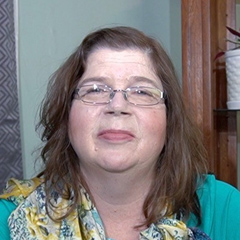
Two Needle Provisional Cast On
Mary Beth TempleWhen knitting, a provisional cast on is a useful skill to be able to work your fabric in opposite directions. There are several variations of the provisional cast on, and which one you choose depends on personal preference and what’s right for your knitting project. In this video, knitting expert Mary Beth Temple demonstrates how to work a two-needle provisional cast on. This particular provisional cast on is interesting due to the use of a spare circular needle.
To begin, Mary Beth starts with two knitting needles, one for her swatch (or project) and then a spare circular needle. The spare circular needle should be of similar size or slightly smaller than the project needle for ease. Leaving a few inches of a yarn tail to weave in later, Mary Beth places a slip knot onto the spare needle, sliding the slip knot onto the cable of the needle. She notes that the slip knot does not count as a stitch and will be removed later. She then works the two-needle provisional cast on as follows:
1. Yarn over the project needle from front to back
2. Bring project needle under the cable of the spare needle and yarn
3. Bring project needle up in between and spare needle and yarn
4. Yarn over from front to back and bring the project needle under the cable of the spare needle
She repeats steps 1 – 4 until she has the desired number of stitches cast onto the needle. Once the stitches are cast on, she knits a few rows in Stockinette stitch (knit on Right Side/purl on Wrong Side)
When Mary Beth is ready to work on the stitch that were cast on provisionally, she does so in a second color of yarn, so that it is easier to see. She notes that it appears that there is one more stitch on this edge; however, the extra stitch is the starting slip knot and can be removed from the needle.
To knit the stitch off the spare needle, Mary Beth uses the project needle and begins knitting each stitch on the Right Side of the fabric. She notices that every other stitch is oriented the opposite direction, so she knits a stitch and knits the next stitch through the back loop. She repeats this down the row so that none of the stitches are twisted.
Share tips, start a discussion or ask other students a question. If you have a question for an expert, please click here.
Already a member?
2 Responses to “Two Needle Provisional Cast On”
Hi guys, Mary Beth Temple here, on behalf of The Knitting Circle. And in this video, we're going to learn a provisional cast on, which is a cast on we use when we want it to go away later, and we're going to do that with two needles. Now there's other ways to do it but this is the two needle version. So let's go ahead and learn how to do it. I have the knitting needle that I want to make my project on, and then I have a spare cable needle.
The size relative to each other is not important. Sometimes it's easier to get a slightly smaller one for this, and you'll see why later, but it doesn't have to be the exact same size. We don't need to worry about that. So the first thing I'm going to do just a few inches in from the cut end, I'm going to go ahead and make a slip knot. I'm going to put that on my spare or provisional needle and that does not count as a stitch.
I'm just putting it there to keep my yarn anchored and out of the way. So now I have my project needle, I have my spare cable, and I have my tail over here which I'm hanging on to until I get started. And then here is my working yarn attached to the ball of yarn. So the first stitch, I'm just going to yarn over from front to back like that. For the next stitch, I'm going to go under the cable needle on the yarn.
I'm going to bring my needle tip up between the cable needle and the yarn. I'm going to go over that yarn from front to back and I'm going to grab it, pull it under that cable needle, and pull the whole ball game up. So now I have two stitches on my top needle. One, two. Yarn over for the third.
Under the cable in the yarn, up between the cable in the yarn, over the yarn and under the whole ball game to pull it up onto the needle. So now I have one, two, three, four up here. Once again, yarn over, that's five, under in between, over, pull it up. That's six, seven, eight, nine, So let's just go with 10 for right now. So to go ahead and knit on my project, I am going to let that cable needle hang.
And if you happen to have an interchangeable set, and you want to just use a cable down there and not the needle, you can do that. Go ahead and put your stoppers on either side of the cable so you don't lose any stitches. Now, the stitches that are up here on your regular needle you can knit or purl or do your lay stitch or whatever stitch your project calls for. I'm going to go ahead and put a couple of rows on this so we can get a good idea of what we're doing. And then we're going to take a look at how to work on those provisional stitches.
Here's my piece. I put a few more rows on it and then I'd have placed those stitches on a stitch holder, so we can set those aside and deal with them later. Now, I'm going to go ahead and knit the provisional stitches, and I'm going to use a different color yarn so you can see what actually is happening. So, these are the stitches that I just knit on. These were the ones that were attached to the working yarn.
So now, to work on those provisional stitches, I'm going to turn the work upside down and here they are on the cable and I'm going to slide them up onto the needle. Now, remember moving forward, this needle that I used for my provisional needle is not the same size as my project needle. So make sure that you remember to get your project needle size up. Now let's count. We have one, two, three, four, five six, seven, eight, nine, 10, 11.
And the reason it looks like 11 is this slip knot at the very beginning, which is what we used to anchor the yarn, that does not count as a stitch. Boop! So now it's gone. Now, the next thing I want to talk about is the way that these stitches are seated on the needle. As you know cause I tell you guys all the time, when you're picking up stitches or working off provisional stitches you want the right leg of the stitch towards the front of the needle.
So here's my first stitch. Here are my two legs and my right leg is towards the front. Now, if I look at my next stitch the right leg is towards the back, then it's towards the front, and it's towards the back. Then it's towards the front. Then it's towards the back.
That is just something that happens with this particular cast on, and this is how we fix it. So we're going to knit the first stitch as we always would, and again I'm just joining a second color so you can see how nice and neat this is because that right leg was in the front. I'm knitting it the way I would always knit it. Now because my next stitch is seated so that the right leg is in the back, I'm going to knit through the back loop. And I'm doing this because I don't want the stitches to twist.
Right leg in the front knit in the front, knit in the front like I always would. If the right leg's in the back, we're going to knit through the back loop. And it will be every other stitch. So, front, back, front, back, front, back. So now I have knit all of the provisional stitches.
Let's get it right up there so you can see. And because I alternated knitting through the front loop and the back loop depending on where the right leg of the stitch was seated, I have no twists or anything crazy like that. I can get rid of that provisional needle cause I don't need it anymore. I'm back to my project size, and now I can knit or purl or whatever my project calls for, just moving right along. So one of the advantages to using this provisional cast on as opposed to some of the other ones, you don't require any waste yarn which is nice.
And also because you're only using one strand of yarn at the beginning, you don't have to pull out a bunch of yarn and sort of guess how much you need. Some of the provisional cast on's that are based on a long tail... Have you ever done a long tail cast on and you're going and you're going and you're going and you hadn't quite pulled out enough yarn at the beginning, and so you run out, so you have to take it out and start again? So one of the advantages of this, because you're only using one strand of yarn for the cast on, not two like a long tail variation, you don't have to pull out yarn at the beginning so there is no guesswork. So there is my second half of my provisional cast on with two needles.
So that's all there is to the two needle provisional cast on. I'm Mary Beth Temple here at The Knitting Circle. Thank you so much for joining me and feel free to check out all the other wonderful videos we have for you here. Bye bye.

This is a great tool! I’m wondering if, at the point where you switched to a new yarn, those provisional stitches can just be joined with the other edge as for a hat brim? Reorienting the stitches as you go, of course. Or do you need to work that first row before joining?
Brilliant, thank you for demonstrating that so clearly.